The First Key That Was Truly Mine

The afternoon I carried my nine-day-old daughter, Lily, through the front door of my first house, I stood in the entryway longer than I needed to, one hand supporting the back of her tiny head while the other remained wrapped around a brass key that had already begun to leave a faint indentation in my palm.
Outside, late-October sunlight filtered through the red maples lining our quiet street in a suburb outside Columbus, Ohio, and somewhere two houses away a lawn mower hummed with the ordinary persistence of suburban life. Inside, there were still cardboard boxes stacked against the walls, a dining table had not yet been delivered, and the living room contained nothing but a floor lamp, a secondhand rocking chair, and three unopened packages of diapers.
To anyone else, it probably looked unfinished.
To me, it looked like freedom.
I pressed my cheek against Lily’s soft hair and whispered, “We’re home, sweetheart.”
Then, after a moment, I added something I had waited most of my life to say.
“And nobody gets to decide what happens here except us.”
At thirty-three, I understood how strange it was that owning a modest three-bedroom house could feel like such an enormous emotional achievement, but my childhood had taught me that square footage and freedom were not necessarily the same thing.
My mother, Elaine, had always loved us fiercely, but somewhere along the way she had confused loving people with managing them.
She managed what my sister and I wore, who we spent time with, how long we stayed on the telephone, which extracurricular activities were worthwhile, and eventually which colleges she thought were acceptable. She entered bedrooms without knocking because, as she liked to remind us, parents should have nothing hidden from them. If I disagreed with her, she rarely raised her voice. Instead, she would become wounded and quiet, which somehow made disagreement feel crueler than shouting ever could.
For years, I mistook surrender for peace.
My younger sister, Brooke, learned a different strategy. She stayed close to our mother, accepted her advice, and eventually stopped noticing where advice ended and control began.
I went the opposite direction.
At nineteen, I moved four hours away for college. After graduation, I stayed in central Ohio and became a speech therapist working primarily with elementary-school children. I loved the work because progress rarely came through force. A frightened child would not speak because you ordered him to. A frustrated child would not trust you because you reminded her that you knew better.
You waited.
You listened.
You created enough safety for another person to find her own voice.
It took me an embarrassingly long time to realize I was teaching children the very thing I had never learned to give myself.
By thirty, I had built a comfortable life. I rented a small apartment, drove a sensible car, contributed faithfully to retirement, and transferred money into a house fund every month.
Then I met Adam.
For almost three years, I believed we were building toward marriage. When I learned I was expecting Lily, however, the future I thought we shared began quietly disappearing. Adam did not become openly cruel. In some ways, that might have been easier to understand. Instead, he simply became less present—longer hours at work, fewer conversations, vague answers about the future—until one evening during my fifth month, he admitted he was not prepared for the life we had been planning.
A week later, he moved out.
I spent several days believing my world had narrowed.
Then something unexpected happened.
It widened.
I looked at the savings account I had spent nearly a decade building and realized I no longer needed to wait for another person before beginning my life.
Six weeks before Lily arrived, I bought the house on Willow Bend Court.
It was nothing extravagant, just a cream-colored 1960s ranch with dark shutters, a small fenced backyard, and an enormous maple tree leaning over the driveway. But the kitchen received morning sunlight, the elementary school was nearby, and one bedroom had a wide window overlooking the backyard.
I painted that room pale blue-gray myself.
My mother hated the color.
“Babies need warmth,” she told me during a video call. “You should have done something softer.”
I laughed.
“Good thing you don’t have to sleep in there.”
She did not laugh.
That should have warned me.
The Plan Nobody Asked Me About
Three weeks before Lily was born, a package arrived at my house containing several rolls of packing tape and labels.
I had ordered neither.
The shipping receipt listed my mother’s name.
When I called her, she dismissed it as a mistake.
“I probably clicked the wrong address,” she said. “Don’t make everything into a mystery.”
Two days later, Brooke casually mentioned that Mom had been helping her organize the basement.
That seemed harmless until Brooke added, “She says your place has a lot more room than you realize.”
Something tightened inside me.
Brooke and her husband, Ryan, had been having financial trouble for months. Ryan had recently lost his position managing inventory for a regional furniture distributor, and Brooke’s income as a preschool assistant could not comfortably support them and their two children.
I loved my sister.
I loved my niece and nephew.
But I also knew my mother.
So before Lily arrived, I made my expectations painfully clear.
For the first two weeks after coming home, I wanted no overnight guests. My doctor had recommended quiet, rest, and minimal stress because my blood pressure had been elevated toward the end of the pregnancy. More importantly, I simply wanted time to learn how to be Lily’s mother without a committee observing me.
When I told Elaine, she stared at me through the screen.
“Two weeks?”
“Yes.”
“Your own mother?”
“Everybody.”
She gave a thin smile.
“We’ll see how you feel once reality hits.”
Reality arrived nine days after Lily did.
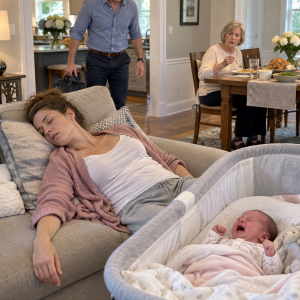
It was a little after eight on a Thursday evening. Lily had finally fallen asleep beside me, and I was eating reheated vegetable soup while sitting in the rocking chair because the new sofa still had not arrived.
My phone rang.
Mom.
I answered quietly.
“Hey.”
“Good, you’re awake,” she said. “I wanted to tell you the plan before tomorrow gets hectic.”
The spoon stopped halfway to my mouth.
“What plan?”
She spoke with the brisk confidence of someone discussing arrangements that had already been approved.
She and my stepfather, Martin, would arrive around ten the next morning. Brooke and Ryan would come separately with the children. Mom would use the small bedroom near the kitchen because she woke early. Brooke and Ryan would use the guest bedroom. Their children could sleep in Lily’s nursery for a while.
I honestly wondered whether exhaustion had caused me to misunderstand her.
“For how long?”
There was a pause.
“Honey, Brooke can’t keep paying that rent. You know that. This gives them time to get back on their feet, and I can stay for a few months to help you with the baby.”
A few months.
I looked toward the hallway.
My hallway.
My bedrooms.
My daughter’s nursery.
“Mom, nobody asked me.”
She sighed.
“That’s exactly the problem. You’re trying to do everything yourself because you’re too proud to admit you need family.”
“I didn’t say I needed anyone to move in.”
“You’re alone with a newborn.”
“I’m her mother.”
“And I’m your mother, which means sometimes I can see what you need before you can.”
There it was.
The sentence beneath nearly every argument we had ever had.
She knew.
I did not.
“No,” I said.
She became quiet.
“Excuse me?”
“Nobody is moving into this house.”
Her voice hardened.
“Don’t be childish, Megan. Brooke needs somewhere to go, and you have three bedrooms. Family helps family.”
“Helping is something you ask someone to do. You don’t assign yourself rooms in another person’s house.”
She laughed once, without humor.
Then she said something I would remember for years.
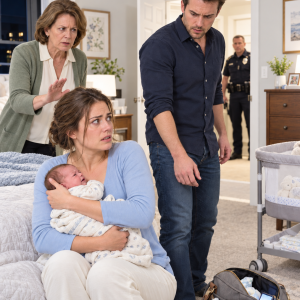
“If you’re going to be this difficult, maybe you and Lily should stay somewhere else for a few days while everybody settles in.”
I stared at the wall.
For a moment, I genuinely had no response.
My mother had just suggested that I leave the house I had purchased so she could move other people into it.
Something inside me became very still.
Not angry.
Still.
“What time are you coming?” I asked.
Her tone softened immediately, apparently interpreting my question as surrender.
“Around ten.”
“Okay.”
I ended the call.
Then I sat beside my sleeping daughter and understood that if I gave in tomorrow, it would not end tomorrow.
The house would become another version of my childhood bedroom—a place that technically belonged to me but where somebody else decided when the door could open.
I picked up my phone.
The Night I Changed the Locks

The first person I called was my friend Claire Benton, a real-estate attorney I had met years earlier through work.
I apologized for calling late and explained the situation.
She listened without interrupting.
When I finished, she asked one question.
“Whose name is on the deed?”
“Mine.”
“Only yours?”
“Only mine.”
“Then stop talking like you need permission.”
I almost laughed.
“I don’t want a huge scene.”
“Then don’t create one. Be clear. They cannot move into your house without your consent.”
Claire offered to come by the following morning.
My second call was to Thomas Avery, an old friend of my father’s.
Dad had been gone for many years, but Thomas had remained one of those rare adults who never treated my childhood as something I had imagined. He had watched my parents’ marriage unravel and understood my mother’s ability to turn pressure into something that sounded remarkably like concern.
When I explained what was happening, he was silent for several seconds.
Then he said, “I’ll be there at nine-thirty.”
“You don’t have to.”
“I know.”
That was Thomas.
He came because he wanted to, not because he needed to control what happened after he arrived.
Before going to bed, I called a locksmith.
By midnight, every exterior lock had been changed.
It might sound excessive, but Brooke had once been given an emergency key while I was heavily pregnant, and I suddenly realized that I had no idea who might have copied it.