The Two Girls

For thirteen years, I believed I understood why my husband had walked away.
I believed grief had simply asked more of him than he could give, that losing one of our twin daughters had broken something inside him so completely that he could no longer remain in the house where her voice seemed to linger in every hallway, every bedroom, every ordinary object she had once touched.
It was an explanation I hated, but eventually I learned to live with it.
Then, on the night my surviving daughter turned eighteen, my father placed an old cardboard box on my kitchen table and told me that almost everything I believed about those thirteen years was incomplete.
Before I tell you about that box, though, I have to tell you about my girls.
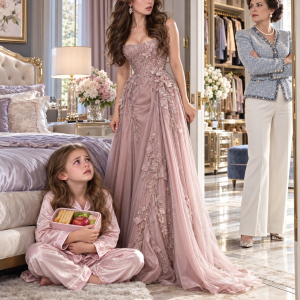
Claire and Sophie Mercer were born eight minutes apart on a bright June morning outside Richmond, Virginia, and although they looked so much alike that even relatives sometimes confused them, their personalities seemed determined from the beginning to travel in opposite directions.
Claire was careful. She watched before she acted, thought before she spoke, and approached the world as though everything deserved to be understood before it was trusted.
Sophie was motion.
She climbed before she should have been climbing, ran before she had mastered walking, laughed at her own jokes, and could begin a conversation with a stranger in a grocery store as naturally as if they had known each other for years.
My father, Walter, used to sit on our back porch watching them play and say, “Those two are one little machine. Claire is the brakes, Sophie is the engine.”
My husband, Nathan, always laughed when he said it.
Nathan was an architectural estimator then, a practical man whose affection rarely came through grand speeches but appeared everywhere in the small things. He remembered which stuffed animal belonged in which bed, cut sandwiches differently because each girl insisted hers tasted better a certain way, and could tell which daughter was laughing from another room.
We were not extraordinary.
That is important.
We were simply happy in the quiet, ordinary way that people rarely recognize as extraordinary until it is gone.
Then, when the girls were five, Sophie became ill at school.
That morning had contained nothing unusual. She complained that her head hurt, I gave her something mild and sent both girls to kindergarten, assuming she was tired.
Before noon, the school called.
By the time I reached the hospital, there was nothing the doctors could do.
Sophie had been born with an undetected weakness in a blood vessel in her brain. No one had known. There had been no warning significant enough for us to recognize.
One ordinary morning she was arguing with her sister about who had taken the purple hair clip.
By afternoon, our family had become something else.
I never had a final conversation with her.
For years, that was the thought that returned most often. My last words to Sophie had been about fastening her seat belt properly. She had sighed dramatically and said, “Mom, I know.”
That was it.
No beautiful farewell. No final wisdom.
Just a mother reminding her little girl about a seat belt.
The Second Goodbye
Three days after the memorial service, Nathan sat across from me at our kitchen table.
Claire was asleep upstairs, exhausted from a week no five-year-old should have had to understand.
Nathan looked different. Not angry, not distant exactly, but strangely settled, as though he had already crossed some invisible bridge and was waiting for me to realize I could not follow.
“Rachel,” he said quietly, “I’m sorry. I can’t do this anymore.”
At first I thought he meant the grief.
“Neither can I,” I whispered.
He shook his head.
“That isn’t what I mean.”
Then he told me he was leaving.
I stared at him, waiting for the rest of the sentence.
There wasn’t one.
He had already packed a bag.
I remember watching him walk toward the front door and thinking surely he would turn around. Surely a man who had spent five years kneeling beside two little beds every evening could not simply disappear from the remaining child’s life.
But he left.
For a long time afterward, anger was easier than sadness.
Nathan had abandoned us when we were already struggling to stand. That became the story I told myself because it gave the senselessness a shape.
Fortunately, my father stepped into the space Nathan left behind.
Walter Bennett had spent thirty-six years teaching physics at a public high school, and retirement had done nothing to change his conviction that most problems became more manageable if you showed up consistently and dealt with what was directly in front of you.
He picked Claire up from school when I worked late. He sat through dance recitals and science fairs. He taught her to ride a bicycle, then later taught her to drive. When money became tight, he quietly covered expenses and brushed away my protests.
“I have savings,” he would say. “Stop worrying.”
So I stopped asking.
Years passed.
Claire grew.
And slowly, painfully, our lives became lives again.
The Eighteenth Birthday
Claire turned eighteen on a Saturday.
We had a crowded dinner at my house with family, neighbors and several of her closest friends. My father came early and stayed late, as he always did.
By eleven, Claire had gone upstairs.
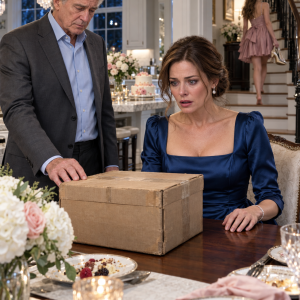
I was alone in the kitchen stacking plates when Dad walked in carrying a small cardboard box.
His face immediately made me put down the dish in my hands.
“Dad, what’s wrong?”
He placed the box on the table.
My name was written across the lid.
I recognized the handwriting before my mind allowed me to recognize it.
Nathan.
My father pulled out a chair but didn’t sit.
“I made a promise thirteen years ago,” he said. “I thought I was protecting you by keeping it. I’m not sure anymore that I did the right thing.”
I stared at him.
“What promise?”
He looked toward the box.
“Nathan asked me not to give you this until Claire turned eighteen.”
For a moment, I genuinely could not understand the sentence.
“You’ve spoken to Nathan?”
Dad’s eyes dropped.
“Yes.”
The room seemed to tilt.
“For how long?”
His answer was almost a whisper.
“All thirteen years.”
I sat down.
There are betrayals born from cruelty, and then there are betrayals born from love so frightened that it convinces itself secrecy is kindness.
At that moment, I did not yet know which kind I was facing.
I opened the box.
The first thing inside was a letter.
What Nathan Never Told Me
Nathan had written the letter the night before he left.
He began by apologizing, not for leaving exactly, but for choosing what he called “the only kind of protection I knew how to give.”
Four months before Sophie’s medical emergency, Nathan had learned that he had a progressive neurological condition.
He had told no one except his physician.
Not me.
He had spent those months trying to understand what the coming years might look like, hoping he would have time before he had to tell me.