PART 1 — THE WOMAN SHE THOUGHT I WAS
The morning my future mother-in-law decided to explain to thirty-seven people why I was not quite good enough for her son, I had already spent seven hours trying to keep a man’s heart beating correctly.
Patricia Whitmore did not know that. More importantly, she had never bothered to ask.
Our engagement brunch was being held at a private country club outside Boston, the kind of place where the flower arrangements were taller than some children and servers replaced your water glass before you noticed it was half empty. My fiancé, Daniel, sat on my right. His father, Robert, was two seats away, while Patricia occupied the head of the table as naturally as if the engagement were hers.
I had known Daniel’s family for six weeks. That had apparently been enough time for Patricia to construct an entire version of me from three incomplete conversations.
The misunderstanding had started at our first dinner when she asked where I worked.
“St. Matthew’s Medical Center,” I told her.
“Oh. What department?”
“Cardiothoracic surgery.”
Before I could say anything else, she smiled and touched my wrist.
“How nice. So you’re a nurse.”
I had been a nurse once, during the earliest years of my career, and I had never considered that work something to be embarrassed about. Those years had taught me things no textbook could teach: how frightened people behaved when they were pretending not to be frightened, how families heard only half of what a doctor said when someone they loved was in danger, and how much dignity could depend on the person changing a dressing at three in the morning.
So I didn’t correct her.
Daniel started to.
Under the table, I touched his knee.
Later, driving home, he asked why.
“Because I didn’t lie to her,” I said. “She stopped listening.”
He glanced at me before returning his attention to the road. “You know she’s going to be mortified when she finds out.”
“She could also just ask another question.”
Over the next six weeks, she didn’t.
Instead, Patricia became increasingly comfortable reminding me where she thought I belonged. At a charity dinner, she seated Daniel with physicians, executives, and foundation directors while placing me near the service entrance.
“The main table is mostly for people in leadership positions,” she explained pleasantly.
Daniel immediately pushed back his chair, but I caught his hand.
“It’s fine.”
It wasn’t fine, exactly. I simply wanted to see whether Patricia’s respect depended entirely on what she believed someone could do for her socially.
At another dinner, she spent twenty minutes praising the wife of Daniel’s cousin for having an MBA and then turned to me.
“Of course, there’s nothing wrong with practical work. Hospitals need all kinds of people.”
Robert looked uncomfortable but said nothing.
That interested me almost as much as Patricia’s behavior did.
Daniel did speak up, repeatedly, but there were limits to how many family gatherings I wanted turned into arguments on my behalf. I was thirty-eight years old. I didn’t need my fiancé fighting every battle for me.
The engagement brunch, however, went further.
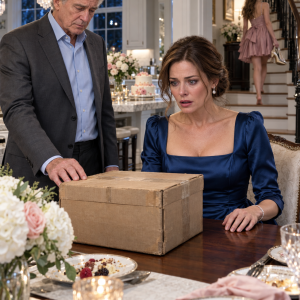
After coffee, Patricia announced that it was time for gifts and slid a rectangular package wrapped in gold paper across the table.
“This one is from me. I think you’ll find it very useful once you’re married.”
Several relatives watched as I removed the ribbon.
Inside was a beginner’s cookbook.
For a moment, I assumed it was simply an awkward gift. Then I opened the cover.
Patricia had written a note in blue ink.
So Daniel doesn’t have to live on hospital food forever.
One of his aunts laughed before realizing Daniel wasn’t.
A cousin looked down at his coffee.
Robert cleared his throat.
I ran my thumb over the edge of the cover and closed the book.
“Thank you.”
Patricia blinked, apparently disappointed.
“You’re welcome. Daniel has always enjoyed a proper dinner.”
“Mom,” Daniel warned.
She ignored him and leaned toward me.
“Marriage is different from dating, Mariana. A successful man needs a wife who knows how to create a home. Love is wonderful, but love isn’t enough.”
I looked across the flowers at her.
“Neither is money.”
The table went quiet.
Patricia’s smile tightened, but before she could respond, my phone vibrated inside my purse.
Only three numbers could bypass silent mode during family events: Daniel, my mother, and the hospital.
The screen showed St. Matthew’s.
I excused myself and stepped into the hallway.
There had been a multi-vehicle collision on the interstate. Eleven injured patients were being distributed among trauma centers, and two coming to us had critical thoracic injuries. The major-trauma protocol had been activated.
They needed me.
When I returned for my purse, Daniel took one look at my face and stood.
“What happened?”
“Pileup on the interstate. I have to go.”
Patricia frowned. “Right now?”
“Yes.”
She sighed as if the timing were personally inconsiderate.
“I suppose they’ll need every pair of hands they can get.”
I put the cookbook into its gold bag.
As I turned away, Patricia spoke again.
“Well, someone has to change the bandages and clean up the mess.”
A few people gave uncertain laughs.
Daniel’s chair scraped sharply against the floor.
“Mom, enough.”
Patricia lifted both hands. “It was a joke.”
“No, it wasn’t. You’ve been talking down to her for six weeks.”
His voice had become cold enough that even Patricia stopped smiling.
I touched his arm.
“Daniel.”
He looked at me. “You shouldn’t have to keep pretending this is okay.”
“I’m not pretending.” I picked up my purse. “I just have somewhere more important to be.”
Thirty-five minutes later, I entered St. Matthew’s through the staff entrance and barely made it ten yards before a surgical resident reached me with a tablet. An anesthesiologist joined us as we walked, giving me the first patient’s vitals, while a scrub nurse told me OR Two was almost ready.
Nobody asked where I belonged.
For most of that night, I moved between operating rooms, imaging, and the ICU. By six in the morning, three patients were stable and one remained critical. I drank half a cup of coffee that had gone cold an hour earlier and began reviewing the next set of scans.
At 7:18, my pager went off.
Urgent cardiovascular consult.
Possible acute Type A aortic dissection.
I left the coffee where it was.
Three minutes later, I stood in front of a CT image that made the muscles between my shoulders tighten. The inner wall of the patient’s ascending aorta had torn, allowing blood to force its way between the layers of the vessel.
If it ruptured completely, we might have minutes.
“Name?” I asked.
The ER physician handed me the chart.
I opened it.
Robert Whitmore.
Sixty-five years old.
Daniel’s father.
Patricia’s husband.
The man who had sat two seats away from me at brunch less than twenty-four hours earlier and quietly watched while his wife gave me a cookbook.
I read the name twice before closing the chart.
“Get OR Three ready.”
The emergency physician studied my face. “You know him?”
“Yes.”
“Do you want me to call someone else?”
It was a reasonable question.
I looked back at Robert’s scan.
There wasn’t time for anyone’s pride, including mine.
“No. If we don’t operate now, he may not make it to noon.”
By the time I reached the surgical waiting area, Daniel was already there. His shirt was wrinkled, his hair looked as if he had been running both hands through it for an hour, and the moment he saw me, whatever composure he had left disappeared.
“Mariana.”
I went directly to him.
“Your dad has an ascending aortic dissection. It’s serious, and we need to operate immediately.”
Patricia was standing several feet behind him with a phone pressed against her chest. Her eyes moved slowly from my face to my navy surgical scrubs.
“What are you doing here?”
I didn’t answer the question.
“The tear is in the main artery leaving his heart. Waiting makes this more dangerous.”
Daniel nodded, trying to follow. “What do you need from me?”
Before I could explain, my charge nurse came through the doors.
“Dr. Carter, OR Three is ready. Perfusion is on the way.”
Patricia turned toward her.
Then back to me.
“Doctor?”
Nobody spoke for a moment.