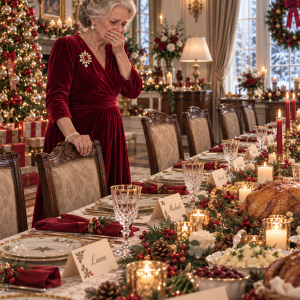
PART 1 — THE THANKSGIVING PLATTER
The turkey platter hit my chest before I could even push back my chair.
Hot gravy soaked through the blue blouse I had ironed that morning, and stuffing slid into my lap before the china struck the hardwood floor and broke cleanly along one edge. Across the table, my son Stuart stood with one hand still extended.
“Go back to the nursing home, you useless old woman!”
For several seconds, nobody moved.
My sixteen-year-old granddaughter, Lily, stared at her father. Her younger brother Max still had his fork halfway to his mouth. Jennifer, Stuart’s wife, looked at the broken platter on the floor.
Then she covered the corner of her mouth.
She was trying not to smile.
I was sixty-five years old. I had never lived in a nursing home.
And before that Thanksgiving was over, Jennifer would slide something across my table that made me wonder whether Stuart’s outburst had been an outburst at all.
THE CONVERSATION THEY HAD ALREADY FINISHED WITHOUT ME
The argument had begun twenty minutes earlier, although at first Stuart tried to make it sound like concern.
I had spent three days preparing Thanksgiving dinner in the Victorian house where Robert and I had lived for thirty-two years. Robert had been gone five years, but Thanksgiving was one tradition I had kept exactly as he liked it: turkey, mashed potatoes, stuffing with too much sage, cranberry tarts, pumpkin pie, pecan pie, and my mother’s china.
Halfway through dinner, Stuart put down his fork.
“Mom, when are you going to get serious about selling this place?”
I passed the mashed potatoes to Lily. “I am serious. I’m not selling it.”
Jennifer folded her napkin beside her plate.
“Nobody’s saying tomorrow, Inz. But a house this size is a lot for one person.”
“I’ve managed so far.”
Stuart gave a short laugh. “Last week you spent ten minutes looking for your glasses.”
“They were on my head.” I smiled at Max. “Which apparently means I qualify for immediate institutionalization.”
Max laughed.
Nobody else did.
Jennifer reached for her wine. “Cedar Grove isn’t an institution. It’s assisted living. There’s a difference.”
I looked at her.
That was the first time anyone had mentioned Cedar Grove.
“Why are we discussing a specific place?”
Stuart glanced at Jennifer before answering. It was quick, but I noticed it.
“Because we’ve looked at options.”
“For me?”
“For your future.”
Then he corrected himself.
“Our future. I mean—the family’s. We need to be realistic.”
Something about that correction stayed with me.
Our future.
I put down my fork.
“My future is not a family asset, Stuart.”
His face changed.
He began talking about the cost of repairs, property taxes, winter maintenance and what would happen if I fell. Some of his concerns were reasonable. That almost made what followed worse.
I told him we could discuss those things another day.
He said I always avoided difficult conversations.
I told him there was a difference between avoiding a conversation and refusing to surrender in one.
His chair scraped backward.
Then came the platter.
After he shouted at me, nobody spoke.
I looked down at the gravy spreading across my blouse and remembered something absurd: Robert had bought that platter for our tenth anniversary because I had complained that the one from our wedding set was too small for Thanksgiving turkey.
Twenty-two Thanksgivings had passed over that piece of china.
It lasted longer than my son’s patience.
I stood carefully.
“Excuse me.”
Upstairs, I changed my blouse and washed gravy from my neck. I waited for tears, anger, anything dramatic enough to match what had just happened downstairs.
Instead, I kept thinking about two words.
Our future.
When I returned, Stuart had poured himself more wine. Jennifer was looking at her phone. Lily and Max looked miserable.
I sat down.
“Who wants pie?”
Stuart stared at me as though calmness itself offended him.
But I served dessert.
Not because I had forgiven him.
Because two children were still sitting at my table.
THE BROCHURE
After dessert, Jennifer reached into her handbag.
The glossy brochure landed beside my plate.
CEDAR GROVE SENIOR LIVING.
A smiling silver-haired couple stood on the cover holding tennis rackets.
“They have an opening next month,” Jennifer said.
I ran one finger along the edge of the brochure.
“You called them?”
“We toured it,” Stuart said. “It’s nice, Mom.”
I looked at him.
“You toured a retirement community for me without telling me?”
Jennifer leaned forward. “We were trying to make this easier.”
“For whom?”
Neither answered immediately.
Stuart finally said, “We put down a refundable deposit so you wouldn’t lose the opening.”
That was when the evening changed for me.
The turkey had been anger.
The brochure was preparation.
I closed it and placed it beside the cracked platter, which I had picked up from the floor after changing my blouse.
“You’ve given me something to think about.”
Stuart’s shoulders relaxed.
He thought I meant Cedar Grove.
I meant him.
WHAT I HEARD IN ROBERT’S STUDY
Six days later, my car was at the mechanic. A neighbor drove me home after lunch, and I entered through the kitchen.
I had barely taken off my coat when I heard the front door open.
Stuart still had an emergency key.
Jennifer’s voice came first.
“Her car isn’t here.”
They walked directly into Robert’s study.
I should have announced myself.
Instead, I stayed where I was.
“The sooner she’s at Cedar Grove, the easier this gets,” Jennifer said.
Stuart sighed. “She won’t go willingly.”
“Then stop fighting with her. Your Thanksgiving performance didn’t exactly help.”
“I lost my temper.”
“I know. So now we do it properly.”
There was a pause.
Then Jennifer said, “We document things. Forgetfulness. Confusion. Bad decisions. Dr. Campbell evaluates her, and if she meets the requirements, the power of attorney becomes usable.”
My hand tightened around the kitchen counter.
After Robert died, I had signed a springing power of attorney naming Stuart as my agent if I ever became incapacitated.
I had considered it responsible planning.
Apparently Jennifer considered it a door.
Then Stuart said, “The house could bring seven hundred thousand. Maybe more.”
Jennifer answered immediately.
“Exactly. Cedar Grove gets paid, she’s comfortable, and there’s no reason the rest of the money should just sit there.”
“It’s Mom’s money.”
I almost stepped into the hallway when he said that.
Then Jennifer replied, “And eventually who gets it?”
Silence.
She continued more softly.
“We could finally breathe, Stuart. Fix the kitchen. Get ahead. Maybe take the kids somewhere. Maybe Europe next summer.”
He didn’t answer.
That silence hurt differently from the shouting.
Before they came out, I put the kettle on.
Twenty minutes later, Stuart appeared in the kitchen and stopped.
“Mom? I didn’t know you were home.”
I stirred my tea.
“Apparently.”
His eyes flickered toward the study.
“We just stopped by to see if you needed anything.”
“How thoughtful.”
I smiled.
And for the first time in my life, I deliberately let my son underestimate me.
THE FIRST CALL I MADE
After they left, I went into Robert’s study and opened the fireproof box.
My pension paid roughly four thousand dollars a month. Robert’s investments had grown more than I had realized. Between savings, brokerage accounts and insurance proceeds I had never needed to touch, I had nearly a million dollars before counting the house.
Stuart knew almost none of that.
The next morning, I called an attorney.
Ellen Price read my power of attorney while I told her what I had overheard.
“Has Stuart ever used this?” she asked.
“Not that I know of.”
“Then we deal with what exists, not what you’re afraid might happen. You’re competent, you’re here voluntarily, and this document can be revoked.”
I signed the revocation that afternoon.
Then I notified my bank and investment firm.
Only after that did I call Martha Reynolds, a realtor I had known for years.
“What can I do for you, Inz?”
I looked through the study doorway at the dining room.
The broken turkey platter was sitting on the table. I had glued the two largest pieces together even though I knew I would never serve food on it again.
“I want to sell my house.”
Martha went quiet.
“Your Victorian?”
“Yes.”
“Does Stuart know?”
“No.”
“Do you want him to?”
I looked at the repaired crack running through the painted border of the platter.
“Not until it no longer matters.”
THE SECOND THING THEY DIDN’T KNOW
The Hendersons made a full cash offer three days later.
They loved the stained glass over the front door and the staircase Robert had restored spindle by spindle. Their offer was clean, and they could close quickly.
I accepted.
That same week, Lily came by after school.
She noticed the boxes immediately.
“Grandma, are you moving to Cedar Grove?”
“No.”
Her shoulders dropped with relief.
Then she saw my face.
“Are you moving because of Thanksgiving?”
I pulled out a chair.
“Thanksgiving clarified some things.”
She twisted the strap of her backpack.
“I should’ve said something when Dad yelled at you.”
“You were scared.”
“I still knew it was wrong.”
Before she left, she gave me a drawing Max had made. It showed an enormous turkey standing between three stick figures.
“He said the turkey should’ve flown away before dinner,” Lily told me.
I laughed harder than I expected.
Then Lily’s expression changed.
“Grandma, Dad’s been weird for months.”