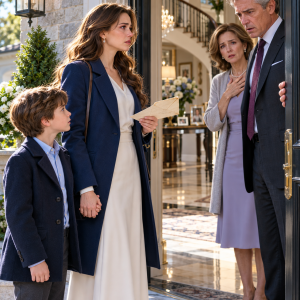
The Message Before Christmas

The message from my father arrived on the first Tuesday of December, while I was standing in our kitchen in Raleigh, North Carolina, trying to pack lunches before my three children came downstairs and turned the quiet morning into its usual blur of missing shoes, unfinished homework, and arguments over who had used the last of the strawberry jam.
My husband, Ethan, had already left for work at the architectural firm where he managed commercial renovation projects, and I was halfway through pouring coffee when my phone vibrated beside the toaster.
Dad rarely texted before nine, so I picked it up immediately.
“We’re going to skip Christmas presents for the kids this year. Things are pretty tight for us right now. Hope you understand.”
I read the message twice.
Then a third time.
My father, Walter, had spent most of his career managing a regional hardware distribution company before retiring several years earlier, and although my parents were hardly wealthy, they had always lived carefully enough that I had never known them to face serious financial trouble. They owned their home outright, drove ordinary cars, and treated restaurant coupons like small personal victories.
My first thought, therefore, was not about Christmas presents.
It was about them.
I called immediately, but Dad declined the call and texted instead.
“Everything’s fine, honey. Just watching expenses. No need to worry.”
That should have reassured me, but somehow it didn’t.
“Are you sure? If you or Mom need anything, tell me.”
A minute later, three dots appeared.
“We’re okay. Just need everyone to be understanding this year.”
Everyone.
That word mattered later.
At the time, however, I accepted it exactly as he intended me to.
I had spent most of my forty years being the daughter who made things easier.
My younger sister, Rebecca, had always been louder about what she needed, while I had learned early that family life ran more smoothly when I adjusted myself around everyone else. If there were two bedrooms and one was nicer, Rebecca got it because she cared more. If our parents could attend only one school event, they usually chose hers because I would understand. When she needed help with rent in her twenties, my parents stepped in; when Ethan and I struggled through the first year after buying our house, I never mentioned it because I knew we would manage.
For years I had called that independence.
Only much later did I understand that sometimes independence is simply what a child calls being overlooked after she has grown old enough to make it sound respectable.
That evening, I told Ethan about Dad’s message.
He was chopping onions at the kitchen counter while our twelve-year-old daughter, Grace, worked on a science project at the dining table, our nine-year-old son, Caleb, searched unsuccessfully for a library book, and six-year-old Sophie sat cross-legged on the floor dressing a stuffed rabbit in doll clothes.
Ethan stopped chopping.
“Both of your parents are okay?”
“Dad says they are.”
He looked at me.
“And they’re canceling gifts for all the grandchildren?”
I remember answering without hesitation.
“Obviously.”
Ethan didn’t argue, although something passed across his face.
Later, when the children were getting ready for bed, I gathered them together and explained that Grandma and Grandpa were cutting back that year.
I expected complaints, especially from Sophie, who still believed grandparents existed partly to produce mysteriously wrapped boxes every December.
Instead, Grace shrugged and said, “That’s okay. We don’t need anything.”
Caleb asked, “Are Grandma and Grandpa having money problems?”
“A little, maybe.”
His face became unexpectedly serious.
“Then they shouldn’t buy us stuff.”
Sophie climbed into my lap.
“Can I make Grandma a picture instead?”
I kissed the top of her head and told her that would be perfect.
For the next week, I felt strangely proud of all of us.
I was proud of my children for understanding that love wasn’t measured in presents, proud of myself for raising them that way, and even proud of my parents for being responsible enough to admit when they needed to reduce expenses.
Then, nine days after Dad’s message, Rebecca posted a video in our family group chat.
And everything I had so carefully believed came apart.
What the Camera Revealed
It was a Thursday evening, and I was folding laundry on the couch while Ethan helped Caleb study spelling words when my phone chimed.
Rebecca had written:
“Grandma and Grandpa couldn’t wait until Christmas!”
Below the message was a video.
I almost ignored it.
Then I pressed play.
Rebecca and her husband lived outside Charlotte in a large brick house with a two-story living room, and the video opened with her three children sitting beneath an enormous Christmas tree covered in white lights.
Wrapping paper was everywhere.
Her fifteen-year-old son, Connor, held up a brand-new laptop.
Her eleven-year-old daughter, Emma, was fastening an expensive smartwatch around her wrist while Rebecca laughed behind the camera.
Seven-year-old Noah was pulling tissue paper from a box containing a pair of sneakers I had seen advertised online for nearly three hundred dollars.
I stared at the screen, trying to understand what I was watching.
Then Dad stepped into the frame.
He was smiling.
Not an uncomfortable smile, not the expression of a man who had reluctantly participated in something beyond his budget, but the enormous, satisfied smile of a grandfather delighted by the reaction he had created.
My mother, Patricia, appeared beside him carrying another package.
“There’s one more!” she announced.
The children cheered.
I stopped the video.
For several seconds I simply sat there with a towel in my hands.
Ethan noticed.
“What happened?”
I handed him the phone.
He watched the entire thing without speaking.
When it ended, he placed my phone gently on the coffee table.
“Claire.”
“Don’t.”
“I wasn’t going to say anything.”
“Yes, you were.”
He sat beside me.
“I was going to ask if you’re okay.”
That almost made me cry.
Not because of the presents themselves.
That distinction became important to me because, afterward, several relatives behaved as though I had become furious over toys and electronics, as though I were a grown woman keeping score over Christmas packages.
But I would have accepted nothing.
If Dad had said, We can’t afford gifts for anyone this year, I would have invited them to dinner, handed them homemade cookies and never mentioned money again.
What hurt was realizing that the financial hardship had apparently applied only to my children.
Grace came downstairs a few minutes later.
“Mom, have you seen my—”
She stopped when she saw my face.
“What’s wrong?”
I turned my phone over.
“Nothing, sweetheart.”
She studied me with that uncomfortable perceptiveness twelve-year-olds sometimes possess.
Then she noticed the frozen image on the television screen, where I had accidentally cast Rebecca’s video earlier.
Her cousins were sitting beneath their Christmas tree surrounded by opened boxes.
Grace understood immediately.
She didn’t ask why they had presents.
She asked something much worse.
“I thought Grandma and Grandpa didn’t have enough money.”
There are moments when a parent realizes that the injury she was willing to absorb herself has reached her children.
That was mine.
I could have invented an explanation.
For most of my life, I had been very good at inventing explanations for my parents.
Maybe the gifts had been purchased months earlier.
Maybe Rebecca had paid for them.
Maybe there was something we didn’t understand.
But Grace was watching me, and I suddenly knew that lying to protect my parents would require teaching my daughter not to trust what she could plainly see.
So I said only, “That’s what I thought too.”
She nodded and went upstairs.
Ethan sat beside me in silence.
After a while, he asked, “Do you want to call them?”
I surprised both of us.
“No.”
I didn’t want an argument.
I didn’t want an apology produced under pressure.
Most of all, I didn’t want to hear another explanation that required me to pretend obvious favoritism was merely an unfortunate misunderstanding.
Instead, I opened the calendar on my phone.
For nearly four years, Ethan and I had talked about taking the kids somewhere special for Christmas. We had saved for it, postponed it, then postponed it again because the roof needed repairs, braces were expensive, and adulthood has a remarkable talent for spending money before you do.
That night, I looked at Ethan.
“What if we go somewhere?”
He smiled slowly.
“Where?”
I thought about the children upstairs, especially Grace and the question she had asked.
Then I said, “Somewhere they’ll remember.”
The Christmas We Chose for Ourselves

Three days later, we booked five nights in Orlando.
We didn’t tell my parents.
We didn’t tell Rebecca.
We didn’t announce anything in the family group chat.
We simply packed.
On the morning we left, I woke the children before sunrise and told them to get dressed because we were going on an adventure.
Sophie stumbled into the hallway carrying her stuffed rabbit.
“Is this a breakfast adventure?”
Ethan laughed.
“A little bigger.”
When we finally told them where we were going, Caleb screamed so loudly that our dog ran into the laundry room.
Grace covered her mouth with both hands.
For the first time since she had seen that video, her face looked completely carefree.
We drove south with Christmas music playing, stopping at roadside diners and arguing cheerfully about snacks, and somewhere after crossing into Florida, I realized I hadn’t checked the family group chat once.
That small realization felt enormous.
Our days were wonderfully ordinary in the way family memories often are.
We stood in long lines.
We ate too much sugar.
Sophie became exhausted every afternoon and insisted she wasn’t tired while practically falling asleep against Ethan’s shoulder.
Caleb developed a temporary obsession with roller coasters.
Grace, who had recently begun acting as though photographs were an embarrassing invention created specifically to inconvenience middle-school girls, voluntarily asked me to take pictures of her with her brother and sister.
On the second evening, we watched fireworks together, and Sophie slipped her hand into mine.
“Mom?”
“Yeah?”
“Grandma doesn’t have to buy me anything.”
I looked down at her.
“No, honey. She doesn’t.”