The Girl Beneath the Awning

By the time I learned that the little girl standing outside my building had been waiting for me, she had already spent nearly two hours beneath a narrow stone awning that did almost nothing to protect her from the cold October rain.
I did not know her name, and until that moment, I did not even know that my wallet was missing.
I had just stepped out of a long meeting on the forty-second floor of Hawthorne Plaza in downtown Chicago, where twelve executives had spent most of the afternoon discussing occupancy rates, vendor expenses, and quarterly projections, when my regional director paused beside the glass entrance and nodded toward the sidewalk.
“Someone needs to get that child out of the rain,” he said. “She’s been standing there since before four.”
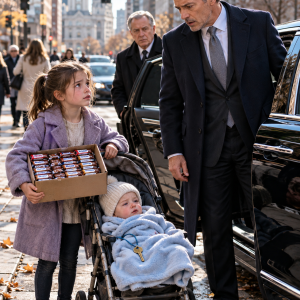
I followed his gaze and saw a small girl who looked about eight years old, wearing a faded purple coat that hung past her wrists and a pair of canvas shoes darkened by water. She held a grocery bag tightly against her chest, as though whatever was inside mattered more than keeping herself warm.
The security officer hurried toward me.
“Mr. Whitmore, I’ve asked her to come inside three times,” he explained. “I offered to keep the item at the desk, but she says she can only give it to you.”
“What item?”
“She says it belongs to you.”
I reached into the inside pocket of my overcoat.
For the first time that afternoon, the numbers from the meeting disappeared from my mind.
My wallet was gone.
I crossed the lobby, pushed through the revolving door, and stepped into the rain. The girl looked closely at my face before opening the grocery bag and removing a dark leather wallet.
“Are you Harrison Whitmore?”
“Yes.”
She did not hand it over immediately. Instead, she opened it carefully, studied the photograph on my driver’s license, and compared it with the man standing before her. Only after satisfying herself that I was telling the truth did she place it in my hand.
“I found it beside a bench near the bus stop.”
I opened the wallet.
My credit cards, identification, access badge, and nearly seven hundred dollars in cash were all there. So was an old photograph I had carried for more than twenty years, tucked behind an insurance card where no one could see it.
My daughter, Caroline, was seventeen in that picture. She was standing on a wooden pier in Maine, laughing as the wind blew her hair across her face. Her mother had taken the photograph during our last peaceful summer together as a family.
My throat tightened before I could stop it.
“Why didn’t you leave this with security?” I asked.
The girl glanced through the glass doors.
“My mom says that if you find something important, you should return it to the person who lost it, not just hand it to somebody else and hope for the best.”
Her fingers were red from the cold.
“How long have you been waiting?”
She looked down at her wet shoes.
“I’m not sure.”
The security officer answered from behind me.
“One hour and forty-seven minutes.”
For several seconds, I could think of nothing to say.
I had spent my entire adult life around people who calculated the value of every minute, and yet this child had surrendered almost two hours simply because she believed returning something properly mattered.
I brought her into the café in our lobby and asked the staff to prepare hot chocolate and something warm to eat. She wrapped both hands around the cup but did not take a sip until I had counted the money and checked every compartment.
“Everything is here,” I assured her.
Only then did she drink.
I removed several bills and placed them on the table.
“I’d like you to have this.”
Her answer came before I finished extending my hand.
“No, thank you.”
“It isn’t payment. It’s a reward.”
“If it isn’t payment, then I don’t need it.”
She said it without pride or performance, and that made her refusal more powerful. In less than five seconds, an eight-year-old child had rejected money that many well-paid adults in my company would have accepted while pretending to object.
I put the bills away.
“What’s your name?”
“Lily.”
“Where is your mother, Lily?”
She pointed across the avenue toward an aging commercial building with a pharmacy on the first floor.
“She had a job interview. She told me to wait in the lobby, but then I found your wallet outside.”
It was almost six o’clock. If her mother’s interview had begun when Lily arrived, it should have ended long ago.
We had barely stepped outside when a woman came running from across the street without an umbrella, weaving between stopped cars as the light changed. She dropped to her knees in front of Lily, took the girl’s hands, touched her forehead, and examined her soaked shoes before she seemed to notice anyone else.
“Can you feel your fingers?”
“They hurt.”
“Good. If they hurt, you can still feel them.”
The woman pulled Lily against her, closed her eyes for a moment, and then looked up at me.
“Who are you?”
“Harrison Whitmore. Your daughter found my wallet.”
She rose, keeping one hand on Lily’s shoulder.
“Claire Bennett.”
I explained where the wallet had been found, how long Lily had waited, and why I had brought her inside. I expected gratitude, perhaps even relief, but Claire’s expression tightened when she heard the length of time her daughter had remained outdoors.
“I told you to wait inside the other building,” she said gently.
“I was going to, Mom, but the wallet had his picture in it.”
Claire sighed and brushed wet hair from Lily’s forehead.
“You did the honest thing, sweetheart, but next time you ask an adult for help before you stand outside that long.”
Then she turned to me.
“Thank you for giving her something warm.”
It was a sincere thank-you, though it contained none of the admiration I had grown accustomed to receiving from people who knew my name. She spoke to me as one parent speaking to another adult, and although I could not have explained why, I respected her immediately.
The rain was growing heavier, so I offered to drive them home. Claire started to decline, but one glance at Lily’s shoes changed her mind.
They lived in a narrow apartment above a laundromat in Cicero, in a building where the hallway lights flickered and the radiators worked only when they felt inclined. Claire invited me in long enough to dry my coat while Lily changed into warm clothes.
The apartment was small but carefully kept. A bowl of apples sat in the center of the table, school drawings covered one wall, and three cans of soup were arranged beside a half-empty bag of rice. On the refrigerator, beneath a magnet shaped like a sunflower, I noticed an overdue utility notice. A second letter lay on the counter, warning that formal action regarding unpaid rent could begin within a month.
Claire saw where I was looking.
“I’m not asking you for money.”
“I wasn’t going to offer it.”
That was not entirely true.
Offering money was my instinctive response to almost every human difficulty, but something about the way Lily had refused my reward made me pause.
“I was going to ask how the interview went.”
Claire gave a tired laugh.
“It was for an overnight custodial position. They wanted open availability, including weekends, but the hourly rate wouldn’t cover child care.”
Lily disappeared into the bedroom, and Claire put on a pot of coffee. While we waited, she told me that she had worked for nine years as a cleaning-team supervisor. The company had gradually reduced staffing while expecting the remaining crews to maintain the same number of buildings. Then management began instructing supervisors to record eight-hour shifts even when employees had worked ten or eleven.
“They wanted you to approve the time sheets?” I asked.
“At first, I thought the discrepancies were clerical errors,” she said. “The second time, I realized they were deliberate.”
“What happened when you refused?”
“They removed me from the better shifts, then from nearly every shift. After a few weeks, they claimed I had stopped reporting for work.”
The anger I felt was not directed at her. It came from recognizing the name of the contractor she had mentioned.
Briarstone Facility Services handled several properties owned by my company.
“Which buildings did your crews service?”
Claire listed four addresses before naming Hawthorne Plaza.
My building.