Part 1 — The Dinner That Changed Everything
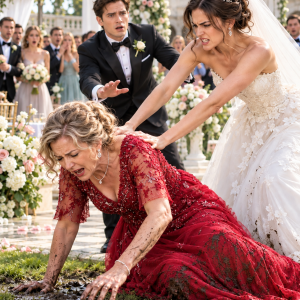
“You seriously expect my son to marry into a family that brings a blind woman to an engagement dinner like this?”
Evelyn Whitmore delivered the sentence with such calculated cruelty that for several seconds nobody around the private dining table moved.
I felt the blood drain from my face while my fingers tightened around the linen napkin in my lap. Beside me, my mother, Eleanor Bennett, remained perfectly still behind her dark glasses, one hand resting lightly on the white cane leaning against her chair.
Across the table, Evelyn lifted her wineglass with the faint, satisfied smile of someone who believed humiliation was a social privilege.
The dinner was supposed to celebrate my engagement to her son, Andrew.
Instead, from the moment my parents entered the private dining room of the upscale Seattle steakhouse, Evelyn had examined them as though she were determining whether they met some private standard of usefulness.
She began with my father’s jacket.
Samuel Bennett had worn a simple charcoal sport coat rather than a designer suit, which Evelyn apparently interpreted as evidence of limited means.
“And what exactly do you do, Mr. Bennett?” she asked.
My father answered with his usual understated calm.
“I oversee several distribution businesses and some related investments.”
Evelyn gave a small laugh.
“Distribution? How charming. Robert’s construction company operates on a considerably different scale, because our annual revenue reaches well into nine figures.”
Her husband, Robert Whitmore, lowered his eyes toward his plate.
Andrew stared into his water glass.
I looked at the man I planned to marry and waited for him to say something meaningful.
“Mom, please, can we just have dinner?”
That was all.
Evelyn continued.
When a server quietly told my mother where the soup bowl had been placed, Evelyn visibly grimaced.
“Do you see what I mean?” she said. “Everyone has to explain every tiny movement to her. Is Andrew eventually expected to become some kind of permanent caregiver?”
My anger rose immediately.
“My mother lives independently and handles her own life perfectly well.”
Evelyn shrugged.
“She still cannot see.”
Three years earlier, a rare autoimmune illness had caused a violent fever and irreversible damage to my mother’s optic nerves. Specialists in several American cities had examined her, and international consultations had produced the same answer.
Her sight would not return.
Eleanor had grieved, adapted, learned mobility skills, and refused to allow anyone to reduce her to a diagnosis.
She slowly turned toward Evelyn’s voice.
“Losing my eyesight has not prevented me from noticing how people treat one another,” my mother said. “In fact, I have learned quite a lot about you this evening.”
Evelyn’s face tightened.
“Are you judging me?”
My mother remained calm.
“I am simply getting to know you.”
The silence that followed felt heavier than anything previously said.
Then my mother’s white cane slipped from the side of her chair and fell onto the floor.
I immediately bent down.
Evelyn moved first.
With the toe of her expensive heel, she deliberately kicked the cane several feet away, sending it beneath a dark cabinet near the wall.
“Honestly, what a nuisance.”
I stared at her.
“That is my mother’s cane.”
Before I could stand, Andrew caught my wrist.
“Lauren, please don’t make a scene.”
Those words hurt more than everything his mother had said.
He was not asking Evelyn to stop humiliating my mother.
He was asking me to make her cruelty easier to tolerate.
Evelyn lifted her chilled white wine.
“The uncomfortable truth is that your family simply does not belong in the same social circle as ours.”
Robert finally raised one hand.
“Evelyn, that is enough.”
Her arm moved suddenly.
The entire glass of wine splashed directly across my mother’s face.
Cold liquid covered Eleanor’s dark glasses, cheeks, neck, and beige silk dress.
I stood so quickly that my chair scraped backward.
My father rose beside me.
Mother did not shout.
She reached blindly for my father’s hand.
Samuel took her fingers, carefully wiped the wine from her face with a clean napkin, and then looked across the table.
I had rarely seen that expression on him.
“I will remember what you just did to my wife for the rest of my life.”
Evelyn laughed nervously.
“Please, don’t dramatize it. She cannot even see the stain.”
Something inside me became completely clear.
I removed my engagement ring.
Then I placed it in front of Andrew.
“We are finished.”
His face went pale.
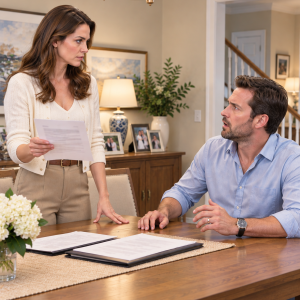
“Lauren, please wait. We can talk about this.”
“I have been listening all evening.”
My father retrieved Mother’s cane and helped her stand.
Before leaving, he looked toward Robert.
“Tonight your family showed us exactly who you are.”
Twenty minutes later, inside the parking garage, my father made one phone call.
“Michael, I want a complete report on Whitmore Construction by tomorrow morning. Every contract, outstanding obligation, compliance issue, safety problem, and every dollar they owe companies connected to us.”
Andrew’s family had no idea who my father really was.
By the following morning, they would.
Part 2 — The Man Evelyn Mistook for Ordinary
At eight o’clock the next morning, senior executives gathered inside a fifty-fourth-floor boardroom overlooking downtown Denver.
My father sat at the head of the table.
Samuel Bennett was not the owner of several modest distribution companies.
He was the founder and principal shareholder of Bennett Holdings, a privately controlled group with extensive interests in logistics, industrial parks, commercial real estate, distribution infrastructure, and corporate finance.
His first company had indeed been a small regional distribution business decades earlier.
He had simply never felt the need to explain what it became.
Michael Grant, his executive secretary, projected Whitmore Construction’s position onto the wall.
“Approximately sixty percent of their active commercial portfolio depends directly or indirectly on Bennett Holdings subsidiaries,” Michael explained. “They are also carrying minimal cash reserves, two bridge loans mature within weeks, and major schedule failures exist on two current developments.”
My father folded his hands.
“I am not interested in illegal retaliation, personal threats, or manufactured financial pressure.”
General counsel nodded.
For almost a year, Bennett Holdings had tolerated missed deadlines, waived contractual penalties, and approved unusually generous financing terms because I was expected to marry Andrew.
My father continued.
“Review every agreement normally. Where a contract expires, decide whether renewal makes commercial sense. Where compliance reviews are permitted, perform them properly. Where financing no longer meets our risk standards, decline it.”
By late afternoon, Robert Whitmore began receiving formal notices.
Two commercial construction contracts would not be renewed.
A third project faced an immediate structural and compliance review because of repeated delays.
Bennett Financial Services also rejected Whitmore Construction’s request to extend a critical multimillion-dollar credit facility.
Robert spent hours studying his financial statements before calling Evelyn.
“Bennett Holdings just closed every door we depended on.”
Evelyn responded impatiently.
“Then go directly to their chief executive.”
Robert became very still.
“What was Lauren’s father’s last name?”
“Bennett. Why does that matter?”
Robert entered the name into his computer.
A photograph from an international economic conference appeared.
Samuel Bennett stood among major industry leaders.
Robert dropped the glass in his hand.
When Evelyn arrived at his office, her face lost all color.
“But he told us he managed distribution companies.”
Robert stared at her.
“Bennett Holdings began as a regional distribution business. He never lied to us. You decided he was insignificant because he did not advertise his wealth.”