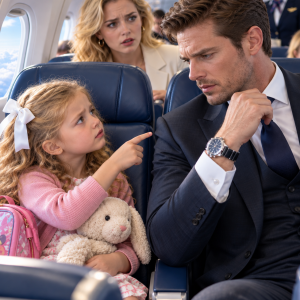
The Girl Beneath the Maple Tree

Sunday afternoons belonged to my daughter, Claire, and I guarded those hours more carefully than any contract I had ever signed. During the week, I was Julian Mercer, founder of a Boston architectural firm whose projects had changed half the city skyline, but on Sundays I was simply the father of an energetic seven-year-old who believed hot chocolate should contain more marshmallows than chocolate and that every walk through the Public Garden required a visit to the duck pond.
That October afternoon, the air had sharpened while we were out, and dry leaves hurried over the paths in little copper-colored swirls. Claire had been holding my hand, telling me in serious detail why she needed a rabbit, when she suddenly pulled away and ran across the grass toward a bench beneath an old maple tree.
“Claire, stop!”
My driver and security manager, Owen Reed, moved at once, but I raised a hand and followed her myself. Then I saw the child curled at one end of the bench, clutching a worn stuffed fox against a thin green sweater. Silver tape covered one toe of each sneaker, her lips were dry, and her hands trembled in the cold. Yet none of those details held me still. It was her face.
She had Claire’s soft, heart-shaped cheeks, Claire’s narrow nose, and the same determined little chin that appeared whenever my daughter believed an adult was being unreasonable. When the stranger lifted her eyes, I felt the world shift beneath me, because they were a clear gray-green—the precise color of my late wife Evelyn’s eyes.
Claire sat beside her as though they had arranged to meet.
“Dad, she looks exactly like me.” Lowering her voice, she added, “I think she might be my sister.”
I crouched several feet away, careful not to crowd her. “What’s your name, sweetheart?”
“Nora.”
“I’m Claire,” my daughter said brightly. “How long have you been sitting here?”
Nora looked toward the path. “Since it was dark.”
It was nearly five in the afternoon.
“Who brought you?” I asked.
“Aunt Denise. She said to wait until she came back.”
“Where is your mother?”
The child lowered her eyes. “She passed away in June.”
Before I could ask another question, her stomach made a small, unmistakable sound. Nora hid it behind the stuffed fox, embarrassed, and Claire caught my sleeve.
“Dad, she’s hungry.”
I had spent years teaching myself to remain composed. I had negotiated with people who mistook cruelty for strength and had rebuilt a life for Claire after losing Evelyn shortly after our daughter’s birth. But the sight of this shivering child, wearing my daughter’s face and my wife’s eyes, opened a crack in defenses I had thought permanent.
I removed my coat and offered it to her. “You don’t have to make any big decision. Come somewhere warm, have dinner, and let a doctor make sure you’re all right. If your aunt returns, she’ll be able to reach us.”
Nora studied Owen and the two men waiting at a respectful distance. “Why do you have so many people?”
“They work with my dad,” Claire answered. “He builds very tall buildings and owns too many blue suits.”
For the first time, the corner of Nora’s mouth moved. Evelyn had smiled that way, as though amusement needed a moment to receive permission. After a long pause, Nora placed her icy hand in mine.
A House That Felt Too Safe
On the drive to Beacon Hill, Claire tucked a wool blanket around both of them and talked enough for three children. Nora listened to stories about an escaped classroom guinea pig and my failure to make pancakes shaped like animals. Gradually her shoulders relaxed, and she accepted crackers and water from Owen.
When Claire asked where she went to school, Nora stared at the floor. “I used to go. Aunt Denise said we moved too often.”
They had stayed in Providence, then in Worcester, and before that in an apartment Nora remembered only by its yellow door. After her mother became ill, Denise had appeared, packed their belongings, and begun moving them from place to place. Nora’s mother had occasionally spoken about her father, but only to say he did not know she existed.
“Did she ever tell you his name?” I asked.
“No. She had a picture, but Aunt Denise took it.”
Dr. Helen Ward, Claire’s pediatrician and one of Evelyn’s oldest friends, arrived soon after us. She paused when she saw the girls together, and the medical bag in her hand tilted.
“Julian,” she murmured.
“I see it too.”
Her examination found cold exposure, mild dehydration, deep fatigue, and the quiet effects of months without steady care, though no immediate medical danger. Nora needed warm food, rest, and a full follow-up once her guardianship could be established.
While Helen packed her instruments, I watched Nora return each item Claire had lent her—the comb, the cardigan, even a pair of clean socks—placing them in a careful pile as though accepting comfort created a debt she could not afford. Claire promptly pushed everything back across the bed.
“They’re yours until you don’t need them,” she declared.
Nora glanced at me, waiting for the adult correction that never came. I nodded, and she touched the soft sleeve of the cardigan with a wonder that made the room feel smaller. It occurred to me that Claire had grown up believing warmth, food, and a safe bed were ordinary facts of life, while Nora had already learned to regard the same things as temporary favors. Their faces might have matched, yet the worlds reflected in their expressions could not have been more different.
In the smaller dining room, she ate vegetable soup, part of a turkey sandwich, and four apple slices before asking, “Am I allowed to have another?”
“You may have as much as you comfortably want,” I told her.
She looked suspicious of such abundance until Claire pushed the plate closer. “He means yes. Sometimes he uses too many words.”
Owen soon called me into my study. No missing-child report had been filed for a seven-year-old named Nora Shaw. Her mother, Rebecca Shaw, had passed away in Providence three months earlier after a serious respiratory infection. Her obituary mentioned a daughter and an older half sister, Denise Harper, but no husband. Denise’s car had entered Boston the previous afternoon and was later found locked in a garage near South Station.
Then Owen handed me an old public record. Rebecca had been born in 1995 to Marjorie Shaw, with no father listed. Marjorie had worked as a seamstress and household assistant for the Whitcomb family from 1989 through 1997.