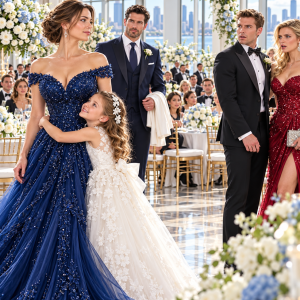
My daughter slapped me in front of sixty people at her baby shower.
Not because we were arguing.
Not because I had insulted her.
I had reached out to steady a gift bag that was sliding off the table, and the back of my hand brushed lightly against her pregnant belly.
Ashley spun around.
Her palm hit my cheek hard enough to knock my glasses crooked.
The room went silent.
“Do not touch my baby.”
I stared at her.
“Ashley, I was just catching the—”
“I said don’t.”
She lowered her voice, but everyone nearby could hear her.
“If you can’t respect that, you won’t be around her after she’s born.”
Her.
My first granddaughter.
For several seconds, nobody moved.
Then someone near the kitchen quietly set down a champagne glass.
I straightened my glasses.
Ashley turned away as if the conversation were finished.
I was sixty-eight years old. My husband, Robert, had been dead for eighteen months. And I had spent the previous six weeks planning nearly every detail of that baby shower.
The flowers.
The catering.
The rented tables.
The cake Ashley had changed twice.
Even the little pink gift bags stacked beside the fireplace.
I had paid for most of it too.
I picked up my purse.
That was when Ashley looked toward the kitchen.
The counters were covered with serving trays, glasses, paper plates, and half-finished desserts.
“Mom.”
I stopped.
She pointed toward the mess.
“Can you clean that up before you go?”
I looked at the dirty dishes.
Then at my daughter.
“No.”
Her expression changed.
“What?”
“I’m going home.”
“There are sixty people here.”
“I know.”
“You’re seriously going to leave me with this?”
I put the strap of my purse over my shoulder.
“Yes.”
I had said yes to Ashley so many times that the word no seemed to confuse her.
When she was twenty-two, Robert and I covered the balance on her college loans.
When her car died two years later, we bought another one.
When she married Kevin, we paid for most of the wedding.
When they ran up credit card debt, we helped.
When they needed a house with more space, Robert said we could work something out.
We always worked something out.
Robert used to call it helping.
Toward the end of his life, he stopped using that word.
Ashley folded her arms.
“You’re being dramatic.”
I touched my cheek.
It was still warm.
“Goodbye, Ashley.”
I had almost reached the front door when someone knocked.
Kevin opened it.
A gray-haired man stood on the porch holding an old brown leather briefcase.
I recognized him immediately.
David Collins had been Robert’s attorney for more than twenty years.
“Linda.”
He looked past me at the crowd.
“I hope I’m not too late.”
The Briefcase Robert Left Behind
Ashley frowned.
“Mr. Collins? Why are you here?”
David stepped inside.
“Your father asked me to be.”
That brought the room quiet again.
Ashley glanced at me.
“Dad?”
David nodded.
“There are instructions Robert left with me. They couldn’t be addressed until certain conditions were met.”
Kevin moved closer.
“What conditions?”
David looked at Ashley’s stomach.
“The first was the anticipated arrival of Robert’s first grandchild.”
Ashley put a hand over her belly.
“And the second?”
David didn’t answer immediately.
His eyes moved around the room.
Several guests were still watching us.
Finally, he said:
“A documented circumstance involving Linda.”
Ashley went pale.
“What does that mean?”
David looked at me.
“Linda, may we sit somewhere private?”
Ashley stepped between us.
“If this concerns my inheritance, I should be there.”
David gave a small nod.
“Yes. You should.”
We went into Ashley and Kevin’s home office.
David placed the leather briefcase on the desk.
Kevin closed the door.
Then David asked me what had happened.
I told him.
Ashley interrupted twice.
“I didn’t hit her like that.”
Then:
“She touched me after I’ve told her I need boundaries.”
David didn’t argue.
He simply asked:
“Were there witnesses?”
Kevin let out a frustrated breath.
“The entire party was standing there.”
David wrote something down.
Ashley stared at him.
“Why does that matter?”
He opened the briefcase.
Inside were several folders and a letter in Robert’s handwriting.
I knew that handwriting before David even turned the page toward me.
My husband always made his capital R too large.
I reached for the letter but stopped before touching it.
“When did he write this?”
“About four months before he died.”
David explained that Robert had spent his final year reviewing our estate.
Whitmore—now Miller Residential—had started with one duplex Robert and I renovated ourselves when we were thirty-one.
By the time we sold the company, we had done well.
Very well.
But we never lived as though we were wealthy.
Ashley did.
And, according to David, Robert had become increasingly worried about that.
David opened another folder.
“Over roughly twelve years, Robert calculated that you and he provided Ashley with more than six hundred thousand dollars in direct financial assistance.”
Ashley laughed once.
“That’s ridiculous.”
David slid a summary across the desk.
She stopped laughing.
I didn’t need to read every line.
I remembered most of them.
Tuition.
The wedding.
The car.
Credit cards.
Home repairs.
Insurance.
The down payment—or what I had always called the down payment—on the house we were sitting in.
Kevin leaned over the document.
“This doesn’t mean anything. Parents help their children.”
David nodded.
“Robert agreed. Until he became concerned that helping had become an expectation.”
Ashley looked at me.
“Did you know about this?”