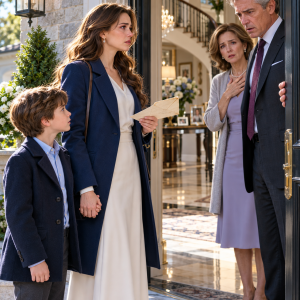
“This House Doesn’t Need You Here Anymore”
“This house doesn’t need you here anymore.”
Jessica said it while standing beside a black suitcase she had placed in the upstairs hallway.
My suitcase.
I was sixty-three years old, three weeks out from minor knee surgery, and I had just finished washing the pie plate from the apple pie I’d brought over that afternoon.
For a second, I thought she meant I shouldn’t stay that night.
Then I noticed my blue cardigan folded over the suitcase handle.
“I packed the rest of your things,” she said.
I looked past her toward the guest bedroom.
The closet door was open.
My overnight clothes were gone.
So were the slippers I kept under the bed and the little canvas toiletry bag I’d left in the bathroom.
“Daniel asked you to do this?”
Jessica crossed her arms.
“Daniel agrees that we need more space. He just doesn’t know how to say these things to you.”
That didn’t sound like my son.
But I didn’t argue.
For the past year, Daniel had been the one asking me to stay over.
After my knee procedure, he had called every Friday.
“Mom, just stay the weekend. I feel better knowing you’re not alone.”
So I stayed.
I brought groceries. I cooked Sunday breakfast. Sometimes I folded towels if they were sitting in the dryer. Nothing extraordinary.
Apparently Jessica saw it differently.
“I’m not trying to be cruel,” she said. “But you’re here all the time.”
I picked up the suitcase.
It was heavier than I expected.
“All right.”
She blinked.
Maybe she had expected tears.
Maybe an argument.
Instead, I pulled the suitcase toward the stairs.
Daniel was downstairs in the kitchen, standing at the island with his laptop open.
He looked up.
“Mom? Where are you going?”
I stopped.
Jessica was two steps behind me.
Daniel pointed at the suitcase.
“I thought you were staying tonight.”
There are moments when a lie reveals itself because of one ordinary sentence.
I looked at Jessica.
She answered before I could.
“Margaret changed her mind.”
Daniel frowned.
“You did?”
Jessica walked past me and began collecting plates from the counter.
“She wants to spend more time at her own place. Right, Margaret?”
I held Daniel’s eyes for a second.
Then I said, “We’ll talk later.”
Jessica followed me to the front door.
As I reached for the handle, she lowered her voice.
“The key.”
I turned.
“Excuse me?”
“Your house key. Since you won’t be staying here anymore.”
Daniel was still in the kitchen.
Jessica held out her hand.
I took the small brass key from my key ring.
For five years, it had opened that front door.
I placed it on the entry table beneath the family photograph Jessica had chosen the previous Christmas.
“There you go.”
She picked it up immediately.
I pulled the black suitcase outside.
What Jessica didn’t know was that the key she had just taken from me belonged to a house she didn’t own.
Neither did Daniel.
I did.
The Name on Hawthorne Lane
My husband, Robert, died when I was forty-six.
Afterward, I threw myself into work.
I had spent years in corporate finance, and eventually I started a small consulting practice helping privately owned companies clean up cash-flow problems, renegotiate debt, and prepare for acquisitions.
It grew slowly.
Then it grew quickly.
By sixty-three, I was earning around $45,000 in an average month.
I still drove a six-year-old Lexus and bought sweaters on sale.
Daniel knew my business was successful.
He didn’t know how successful.
Five years earlier, he and Jessica had fallen in love with the house on Hawthorne Lane.
Five bedrooms. Brick front. Wide kitchen. Good school district.
They couldn’t qualify for the financing they needed.
Daniel called me one evening.
“Forget it, Mom. It’s too much house anyway.”
I knew he was disappointed.
So I bought it.
Not gave it to them.
Bought it.
The deed was recorded in my name: Margaret Anne Foster.
The mortgage came from my account every month.
Daniel and Jessica paid utilities, groceries, landscaping, and ordinary household expenses while they worked on improving their finances.
I assumed we all understood the arrangement.
That Sunday evening, after getting home, I left the black suitcase beside my bedroom door.
Then I made one phone call.
Charles Bennett had handled my legal affairs for almost fifteen years.
Everyone called him Charlie.
“Charlie, I need Hawthorne Lane formalized.”
There was a pause.
“Did something happen?”
I looked at the suitcase.
“Yes.”
I told him what Jessica had done.
He didn’t interrupt.
When I finished, he asked one question.
“Does Daniel know she removed you?”
“I don’t think so.”
“And they still have no written occupancy agreement?”
“No.”
Charlie sighed.
“Then it’s time they do.”
That was my first decision.
I wasn’t selling the house.
I wasn’t throwing anyone onto the street.
I simply wasn’t going to continue an informal arrangement with people who had just informed me that I had no place in my own property.
Charlie prepared the paperwork.
A week later, it was delivered to Hawthorne Lane.
Daniel called me at 6:17 that evening.
He didn’t say hello.
“Mom, why is your name on our deed?”
I was sitting at my kitchen table.
“Because it isn’t your deed, Daniel.”
Silence.
“What?”
“The house is mine.”
“No. You helped us buy it.”
“I bought it.”
“Jessica said—”
He stopped.
I waited.
“Mom, we’ve been paying for that house for five years.”
“You’ve been paying the utilities and household expenses. I’ve paid the mortgage.”
Another silence.
Then: