Nobody Had Asked If She Was Hungry
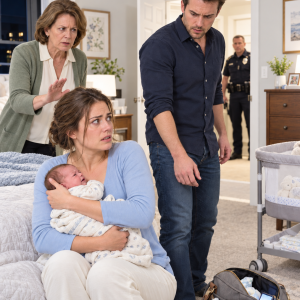
The first time I brought Barbara Miller downstairs for dinner, her daughter-in-law looked at me like I had wheeled a stranger into her house.
Julie Miller set down her wineglass.
“What is she doing down here?”
Barbara’s hands tightened around the arms of her wheelchair.
I stopped behind her.
On the table in front of us were chicken and dumplings, green beans, mashed potatoes, and a skillet of cornbread.
“Mrs. Miller was hungry,” I said.
Julie looked from me to Barbara.
“Her meals are served upstairs.”
Barbara didn’t answer. She was staring at the bowl of chicken and dumplings.
That was the part I remember most.
Not Julie’s voice.
Not the silence.
Barbara staring at that bowl like she recognized something she hadn’t seen in a very long time.
I had been working for the Millers for less than a month.
Their house sat outside Charlotte, North Carolina, in one of those neighborhoods where the driveways curved around landscaped lawns and every house seemed to have more rooms than anybody could reasonably use.
Kevin Miller owned a successful construction company. His wife, Julie, managed the house.
And I mean managed it.
There were schedules for cleaning, grocery deliveries, landscaping, medication, visitors, even when certain rooms were supposed to be used.
Barbara was Kevin’s mother.
She was eighty-nine.
When I started, I was told she had been declining for several months.
“She barely eats anymore,” Julie explained my first week. “Don’t take it personally.”
Kevin had taken his mother to doctors. She had bloodwork, scans, medication reviews, appointments with a geriatric specialist.
Nothing obvious was wrong.
The explanation everybody had settled on was age, possibly depression.
So every afternoon, I prepared Barbara’s food, put it on a tray, and somebody carried it upstairs.
Most evenings, the tray came back almost untouched.
At first, I assumed Julie was right.
Then I started noticing little things.
Barbara always asked what I was cooking downstairs.
She could smell onions from the second floor.
She once asked Donna Harris, the housekeeper, whether Kevin had liked the pot roast.
Another afternoon, I carried up soup myself because Donna was busy.
Barbara looked at the tray.
Then she looked past me toward the hallway.
“Are they eating?”
“Not yet.”
She nodded.
“They’ll eat downstairs later.”
It wasn’t a question.
I put the tray beside her.
There was a television across the room, muted. A weekly medicine organizer sat on the nightstand.
The curtains were half closed.
Barbara picked up her spoon.
“You can go, honey.”
I did.
Twenty minutes later, the soup came back cold.
A few days after that, I found Barbara looking through an old cookbook.
She told me her mother used to make chicken and dumplings without measuring anything.
“She’d pinch the dough between her fingers,” Barbara said. “Never rolled it.”
I asked what she served with it.
Barbara looked surprised that I wanted to know.
Then she started listing things.
Green beans cooked soft. Mashed potatoes. Cornbread.
She talked for almost fifteen minutes.
That evening, I made all of it.
Then I did something I had not been hired to do.
I brought her downstairs.
Julie was already seated.
Barbara looked nervous when we reached the dining room.
“Maybe I shouldn’t,” she whispered.
“You told me you wanted to taste the dumplings.”
She glanced toward the table.
“I did.”
So I pushed her forward.
That was when Julie asked who had given me permission.
I expected Barbara to ask me to take her upstairs.
Instead, she picked up her spoon.
She ate one bite.
Then another.
Julie sat perfectly still.
Barbara kept eating.
Half the bowl disappeared before she said anything.
Her eyes had gone watery.
“It tastes like home.”
I was reaching for the cornbread when the front door opened.
Kevin walked in carrying his briefcase.
He stopped in the dining-room doorway.
“Mom?”
Barbara turned.
Kevin stared at her plate.
“You’re eating.”
Barbara smiled.
It was a small smile, but I hadn’t seen one like it before.
“Megan made Mama’s dumplings.”
Kevin came closer.
Then Barbara said the sentence that changed the room.
“Kevin, they haven’t let me eat down here in a long time.”
Julie pushed her chair back.
“Barbara, please.”
Kevin looked at his wife.
Then at his mother.
“What does that mean?”
Julie stood.
“It means your mother is confused.”
Barbara lowered her spoon.
Nobody spoke.
Julie walked out.
Kevin stayed beside his mother while she finished dinner.
And Barbara finished almost everything on her plate.
The Note on the Kitchen Counter
Donna found me later that night.
She had worked for the Miller family for twenty-six years, long before Julie married Kevin.
She closed the pantry door behind her.
“You need to be careful.”
“About what?”
Donna glanced toward the hallway.
“You stepped into something tonight.”
I told her I had only brought Barbara downstairs.
Donna gave me a tired look.
“Exactly.”
She wouldn’t say much more.
Only that Julie did not like employees changing routines she had established.
The next morning, there was a typed note on the kitchen counter.
BARBARA’S MEALS ARE TO BE SERVED IN HER ROOM.
KITCHEN STAFF SHOULD LIMIT UNNECESSARY INTERACTION.
I read it twice.
Julie came in while I was holding it.
“Any questions?”
“No.”
She seemed surprised.
“Good.”
Two days later, a camera appeared above the kitchen doorway.
It pointed directly toward my prep counter.
I didn’t mention it.
I kept cooking.
And I started writing notes.
Nothing dramatic.
If Barbara had told me about fried apples her husband used to make on Sundays, I wrote:
Found good apples today. Maybe Sunday.
If she mentioned a church picnic from years ago:
Donna remembers those lemon pies too.
I slipped the notes beneath her napkin.
Sometimes Barbara sent one back.
More pepper in the gravy.
Or:
Tell Donna she still owes me a card game.
The strange thing was that Barbara started eating again.
Not full meals at first.
But half a bowl became most of a bowl.
A piece of cornbread disappeared.
Then dessert.
Donna began helping.
When Julie went to appointments or lunch, we brought Barbara to the sunroom or back porch.
We didn’t do anything special.
Coffee.
Toast.
Music.
Conversation.
Barbara talked about her late husband, Frank. She talked about Kevin as a boy and how he once broke a neighbor’s window with a baseball and hid behind the garage for two hours.
One afternoon she laughed so hard she had to put down her coffee.
I remember Donna looking at me across the table.
Neither of us said anything.
Barbara had gained three pounds by her next weigh-in.
That should have been good news.
Julie didn’t treat it that way.
Instead, the rules got tighter.
Then one morning the phone rang while Julie was out.
Donna answered.
A minute later, she came into the kitchen holding the receiver.
Her face looked strange.
“It’s Patty Wilson.”