Hidden Moral Stories

At Nine Months Pregnant, My Husband Left Me at the Edge of an Icy Mountain for a $48 Million Insurance Payout—Then He Brought His Other Woman to My Memorial and Signed the Final Claim… Until the Chapel Doors Opened

The Winter He Thought Had Erased Me

Before that winter, I had spent years convincing myself that a difficult marriage was not necessarily a broken one.

My name is Rachel Fairchild. I was thirty-one, expecting my first child, and living outside Denver with my husband, Mason Caldwell, a luxury resort developer whose charm had once made every room seem warmer when he entered it. By the time I understood how carefully that charm had been constructed, I had already become skilled at apologizing for things I had not done.

Mason controlled our finances, decided which friends were good for me, and had an explanation ready whenever I questioned the late meetings, unfamiliar perfume, or messages he deleted before coming home. He called his behavior protection. I called it marriage because admitting the truth felt harder.

During the final month of my pregnancy, Mason suggested that we spend a weekend at one of his company’s mountain properties near Telluride. He said the quiet would help us reconnect before the baby arrived.

I wanted to believe him.

On our second afternoon there, he asked me to walk with him to a scenic overlook called Whitecap Ridge. Snow had been falling since morning, and by the time we reached the trail, the mountains had disappeared behind a curtain of white.

“We should turn back,” I said. “The path is getting slick.”

Mason kept walking.

“It’s only another hundred yards.”

I followed slowly, one hand beneath my stomach and the other holding the railing where the trail narrowed. When we reached the overlook, there was no view, only wind, snow, and a steep white slope vanishing below us.

That was when I noticed Brooke Sutter standing near the trees.

Brooke was a branding consultant who had worked on several of Mason’s resort launches. She was also the woman whose name appeared repeatedly in the messages he believed he had erased.

I turned toward my husband.

“Why is she here?”

Mason did not answer. His expression had changed, as though the face I knew had simply been removed.

I stepped backward, but he caught my arms.

“Mason, you’re hurting me.”

“It will be quick,” he said.

Then he pushed me beyond the edge.

I remember the sky tilting, the railing passing above me, and my hands reaching for something that was no longer there. I landed on a narrow shelf of snow and stone partway down the slope. The impact emptied my lungs and left me unable to move for several moments, but my first thought was not of myself.

It was my baby.

I placed both hands over my stomach and waited until I felt the smallest movement beneath my palm.

Above me, Mason and Brooke approached the edge.

“Can you see her?” Brooke asked.

“No,” Mason replied. “No one could survive that fall in this weather.”

There was a pause before Brooke spoke again.

“And the policy?”

“Forty-eight million,” he said. “The accidental-loss clause is clear. Once the search is finished, the claim moves forward.”

Their footsteps eventually faded.

For nearly two hours, I remained on that shelf while snow gathered around my coat. I tried to call out, but the wind carried my voice away. Whenever my eyes began to close, I pressed my hands against my stomach and whispered to the child I had not yet held.

“Stay with me, sweetheart. I’m still here.”

Near dusk, a searchlight appeared through the snow.

A helicopter hovered above the ridge while two rescue specialists descended toward me. Behind them came an older man in a dark alpine coat. He had silver hair, pale blue eyes, and a face I recognized from a photograph my mother had hidden inside a sealed envelope for almost three decades.

His name was Thomas Everly.

He was the founder and chairman of Everly Risk & Assurance, one of the nation’s largest reinsurance and emergency-response firms.

He was also my biological father.

The Man Who Had Been Searching

Thomas knelt beside me, and for several seconds, he appeared unable to speak. His gloved hand hovered near my face before settling gently over mine.

“Rachel?”

I managed a small nod.

His eyes closed briefly, as though he had spent years preparing for that moment and had never imagined finding me there.

“I’ve been looking for you since your mother disappeared from my life,” he said. “I found you six weeks ago. I was trying to decide how to approach you without turning your world upside down.”

I later learned that my mother’s former attorney had contacted Thomas after her passing. Among her papers was a letter explaining that she had left him while expecting me because she feared being drawn into his powerful family and losing the ordinary life she wanted.

Thomas had hired a genealogist and private investigator to verify the truth. The investigator had followed Mason to the mountain lodge after noticing several troubling changes to my insurance arrangements, including a recent increase in coverage and an unusual request naming Mason as the sole beneficiary.

When Mason returned from the trail without me and began rehearsing a story about an accidental fall, the investigator alerted Thomas. Thomas had been less than an hour away aboard one of his company’s aircraft.

That accident of timing saved both my child and me.

At a private medical center in Denver, doctors delivered my son by an urgent procedure. He arrived small and quiet, but within moments, the room filled with the sound I had been praying to hear.

A strong newborn cry.
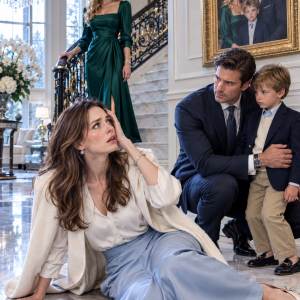
I named him Henry.

Thomas stayed beside us throughout the night. He never demanded forgiveness for the years we had lost, nor did he insult my mother for keeping us apart. He simply sat in a chair near the window, looking from me to his grandson as if he were afraid we might disappear.

On the third morning, he placed a tablet on the blanket beside me.

Mason was giving a televised statement outside the mountain lodge. He wore a dark coat and held a handkerchief near his eyes, though I could see no tears.

“Rachel was my entire world,” he told the reporters. “I watched her lose her footing. I tried to reach her, but the storm made a rescue impossible.”

Brooke stood behind him in a cream-colored coat, pretending to be a concerned colleague.

Thomas switched off the video.

“He filed the insurance claim twelve hours after returning to the lodge,” he said. “He also submitted a sworn statement saying he witnessed an accidental fall. This morning, he asked us to waive the normal investigation period.”

“Why would he think your company would agree?”

“He believes I’m only a name at the top of a building. He has no idea you’re my daughter, and he doesn’t know you were found.”

Mason had also announced a public memorial service at an historic chapel in Denver. He requested that a representative from Everly Risk & Assurance present the settlement authorization during the service, claiming it would allow him to establish a charitable foundation in my memory.

The arrogance of it left me strangely calm.

For years, I had been afraid of Mason’s silence, his anger, and the possibility that he might leave me. Lying in that hospital room with Henry sleeping beside me, I finally understood that the loss I had feared was actually freedom waiting to be accepted.

“Let him believe the claim is approved,” I said.

Thomas studied me carefully.

“What are you suggesting?”

“Prepare the documents. Make him confirm every detail in writing. Let him sign them in front of the guests, the cameras, and your claims officer.”

The authorization would be conditional, Thomas explained. No money would be released, but Mason’s signature would create clear evidence that he had knowingly filed false information.

Thomas’s expression softened with something that looked very much like pride.

“And after he signs?”

I looked toward my son.

“Then we attend the memorial.”

The Ceremony Mason Built for Himself

The Chapel of St. Matthew was filled with white roses, soft organ music, and nearly three hundred guests.

Mason had invited business partners, investors, elected officials, journalists, and anyone else whose sympathy might improve his reputation. A large photograph of me stood near the altar, selected from a charity dinner at which Mason had complained that my dress attracted too much attention.

He stood beneath it receiving condolences.

Brooke sat in the front pew wearing black, her expression solemn whenever someone looked at her and impatient whenever they did not.

At two o’clock, Everly Risk & Assurance’s senior claims director approached the altar carrying a leather portfolio. Several journalists lifted their cameras.

“Mr. Caldwell,” the director said, “before this conditional settlement can be finalized, you must verify that the information in your claim is complete and accurate.”

Mason glanced toward the guests.

“Of course.”

The director turned to the signature page.

“You are confirming that your wife fell accidentally, that you made every reasonable effort to assist her, and that you have no knowledge of any other circumstances contributing to her disappearance.”

Mason did not hesitate.

“That is correct.”

“You understand that knowingly providing false information may lead to federal charges and the cancellation of all benefits?”

“I understand.”

He signed with a silver pen, then looked toward Brooke. For a fraction of a second, satisfaction showed plainly on both their faces.

Mason reached for the portfolio.

The chapel doors opened behind him.

Winter sunlight spilled down the center aisle, and the organist’s hands went still.

I entered wearing a tailored navy suit, with Thomas walking beside me. A faint scar remained along my cheek, but I made no attempt to cover it. It was no longer something Mason had done to me. It was evidence that he had failed to erase me.

Whispers moved through the chapel.

Mason turned.

The confident expression vanished from his face.

“Rachel?”

I continued walking until I stood several feet from the altar.

“Hello, Mason.”

He gripped the edge of the podium.

“This isn’t possible.”

“You seemed very certain when you signed those papers.”

Brooke rose abruptly and moved toward a side door, but two federal investigators stepped into the aisle. Several more agents who had been seated among the guests stood and displayed their credentials.

No one shouted. No one was thrown to the floor. The investigators simply surrounded Mason and Brooke with the calm efficiency of people who had prepared carefully.

The lead investigator addressed Mason.

“You are being taken into federal custody in connection with insurance fraud, conspiracy, aggravated assault, and filing false statements. You have the right to remain silent.”

Mason looked from the agents to the signed document and then back to me.

“Rachel, listen to me. I panicked. The weather was bad. I didn’t know what I was doing.”

For years, his explanations had made me question my own memory. That afternoon, they sounded small and poorly rehearsed.

“You knew exactly what you were doing,” I said. “You just believed I would never be able to tell anyone.”

Brooke began insisting that everything had been Mason’s idea. Mason immediately blamed Brooke. Their loyalty lasted less than a minute once the future they had planned began slipping away.

As the agents escorted them from the chapel, Mason called my name again.

I did not turn around.

Instead, I looked at the photograph near the altar and thought about the woman smiling from inside its gold frame. She had been trying so hard to appear happy that she had almost forgotten happiness was supposed to be real.

I wished I could have told her that she was going to be all right.

The Life Waiting Beyond Him

The legal proceedings lasted seven months.

The evidence included Mason’s signed claim, his recorded statements, financial messages between him and Brooke, the recent policy changes, location data from their phones, and testimony from the investigator who had watched them return to the lodge without me.

A jury found them responsible on every major count. Both received lengthy federal sentences, and Mason’s business holdings were sold to satisfy court-ordered restitution and outstanding debts.

By then, I had moved with Henry to Thomas’s estate near Lake Geneva, Wisconsin.

The property was large, but what mattered to me was not its stone terraces, private gardens, or guarded entrance. What mattered was the quiet.

No one checked my phone.

No one criticized how long I spent with friends.

No one made affection feel like a prize that could be withdrawn whenever I spoke too honestly.

Thomas and I learned how to become family in small, ordinary ways. He made terrible pancakes on Sunday mornings. I teased him about owning six identical navy sweaters. He walked Henry through the gardens every afternoon, narrating business news as though an infant could offer useful financial advice.

He also invited me to join the board of his company, but he did not pressure me to accept.

“You have inherited opportunities,” he told me, “not obligations. Build the life that belongs to you.”

Eventually, I accepted a role overseeing the company’s charitable foundation. We expanded emergency housing and legal-support programs for parents escaping controlling homes. I never used my own experience as a marketing story. I simply remembered how difficult it had once been to imagine a door opening, and I helped build doors for others.

On Henry’s first birthday, Thomas gave me a leather folder containing updated estate documents. A protected trust had been established for Henry’s future, and I had been named Thomas’s successor should I ever choose to lead the company.

“This is not payment for what happened,” he said. “Nothing could repay that. This is simply what should have been yours all along: the freedom to choose.”

Almost a year later, an email arrived from Mason’s public defender.

Mason wanted me to write a letter supporting his transfer to a less restrictive facility. According to the message, he was struggling with isolation and believed my compassion might persuade the court.

I left the email unopened for several days.

Then, one warm afternoon, I carried my phone onto the terrace while Henry played nearby with wooden blocks. For a moment, I remembered the white silence of the mountain and the sound of Mason’s footsteps moving away from me.

The memory was clear, but it no longer controlled my breathing. My hands remained steady.

I realized I did not hate him.

Hatred would have required keeping him present in my life, and I had no space left for him there.

I deleted the message without replying.

The court could decide where Mason belonged. His comfort was no longer my responsibility, just as my fear was no longer his possession.

Henry looked up and held his arms toward me.

I lifted him, and he rested his warm cheek against mine. Through the open doors behind us came the sound of Thomas arguing cheerfully with a cook about the correct way to prepare birthday cake, even though the birthday had already passed.

For most of my marriage, I had believed survival meant enduring whatever happened and remaining unchanged.

I knew better now.

Sometimes survival means allowing an old version of yourself to remain behind—the frightened woman who apologized too often, doubted what she saw, and mistook control for love—while the person who rises afterward walks forward without asking permission.

Mason had taken me to the mountain believing the snow would silence me and turn my life into money.

Instead, the mountain returned my voice, brought my father back to me, and placed my son safely in my arms.

He thought he was writing the final chapter of my story.

He had only introduced me to the woman who would finish it.

Related Posts

My Husband Left Me Injured on the Icy Porch, Then Ordered Me to Host His 41st Birthday Party With My Arm in a Cast—As He Took Credit for the Perfect Dinner Before Twenty-Two Guests, the Doorbell Rang at 7:30… and His Proud Smile Disappeared Before He Even Opened the Envelope

The Ice on Hawthorne Drive For nearly eight years, I told myself my marriage to Travis Rowan was merely difficult. Travis and I were white Americans in our...

My Golden-Child Sister Dragged Me To Court With A “Signed Agreement” To Take My Riverfront Home—But One Question From The Judge, Fourteen Hidden Properties, A Signature Expert, And Security Footage Exposed The Truth… Leaving My Entire Family Speechless

The Morning My Family Tried to Take My Home My younger sister entered the Hood River County Courthouse as though she were arriving at a private celebration instead...

After a Highway Collision Left Me Unable to Walk, My Mother Chose a Pickleball Tournament Over Caring for My One-Year-Old Twins—So I Stopped Funding My Family’s Luxurious Life, but Three Days Later My Sister Arrived at My Hospital Bed With a Gold Pen and the Documents They Were Certain I Had No Choice but to Sign

The Call That Changed Everything The beginning of my freedom did not feel like freedom. It felt like rain striking the windshield, a sudden wall of headlights from...

“Her Mother Has Been Losing Her Mind for Months,” My Husband Was Calmly Telling Everyone My 71-Year-Old Mother Had @ttacked Him First, Until I Asked One Question About a Fireplace That Hadn’t Existed in Twelve Years Made His Entire Story Start Falling Apart

“Her Mother Has Been Losing Her Mind for Months,” My Husband Was Calmly Telling Everyone My 71-Year-Old Mother Had @ttacked Him First, Until I Asked One Question About...

After Leaving Me Hurt, My Husband Drove Away Believing Our Son And I Would Stay Silent Forever—He Never Expected One Trembling Phone Call From Our Five-Year-Old To Grandpa To Begin The Chain Of Events That Left His Old Life Beyond Repair

The Night My Six-Year-Old Son Found His Courage My name is Tessa Langford, and for a long time, I believed keeping a family together was more important than...

Để lại một bình luận

Email của bạn sẽ không được hiển thị công khai. Các trường bắt buộc được đánh dấu *