Hidden Moral Stories

My Father Banned My 7-Year-Old Son From Christmas Dinner—Then I Found Every Other Child Playing Beneath the Tree. I Canceled the $1,200 Monthly Transfers, but My Brother-in-Law’s Next Question Revealed a Contract Signed in My Name

The Empty Chair at Christmas

A week before Christmas, my father called while I was sitting in the parking lot outside my son’s elementary school. His voice was calm, almost businesslike, as though he were confirming a dinner reservation rather than changing the shape of our first holiday season without my husband.

“Your mother wants Christmas Eve to be adults only this year,” he said. “No children, no toys underfoot, no interruptions.”

I asked twice whether that included my seven-year-old son, Elliot. My father paused just long enough for me to understand that he had already rehearsed the answer.

“Yes, Caroline. It includes Elliot.”

Our white American family had lived in central Ohio for generations. Eight months earlier, I had lost my husband, Peter, after a worksite incident outside Columbus. Since then, Elliot had become quieter and more curious. He wanted to know how elevators chose their floors, why the moon followed our car, and whether his father could hear him when he spoke into the dark. Questions were how he rebuilt a world that no longer made sense.

My father, Richard Voss, called them exhausting.

I nearly declined, but I still carried the old habit of keeping peace at any cost. I decided to leave Elliot with Peter’s parents, deliver the gifts, and return before dessert.

That afternoon, Elliot wore the red cable-knit sweater Peter had chosen for him the previous winter. At Frank and Louise Bennett’s house, he stood in the doorway holding a small wrapped box for my parents.

“Do you think Grandpa Richard will like the compass?” he asked.

I looked at his hopeful face and felt the lie rise before I could stop it.

“I’m sure he will, sweetheart.”

When I reached my parents’ home in Bexley, three SUVs with booster seats were parked outside. Through the windows, I saw children running past the tree. Inside, my sister Molly’s daughters decorated gingerbread houses while our cousins’ children played on the rug. There were at least nine children in the house.

Every child had been invited except mine.

The Question No One Expected

For several seconds, I stood in the entryway with the gift bags cutting into my fingers. My aunt came over and asked where Elliot was. My uncle said he had brought a beginner’s microscope for him. No one had heard anything about an adults-only evening.

I found my parents near the dining room.

“You told me there would be no children here.”

My mother, Susan, glanced toward the living room. “Lower your voice. It’s Christmas.”

Molly appeared behind them, folding her arms as though she had been waiting for me.

“Don’t turn this into a scene,” she said. “Elliot is probably happier with Peter’s parents anyway.”

“They are his family,” I replied. “So are you.”

My father stepped closer. “The children here know how to behave. They don’t touch antiques, interrupt conversations, or ask a hundred questions.”

I reminded him that Elliot had been through more in one year than most adults face in ten, and that every teacher he had ever had described him as gentle, thoughtful, and bright.

My father looked toward the crowded living room and said, “These children have earned their place here.”

The sentence settled over me with a strange clarity. For years, I had been taught that belonging was something a person earned by being useful, agreeable, and quiet. Now the same lesson was being handed to my son.

I reached for my phone.

Four months earlier, my parents had claimed my mother needed expensive heart testing. After losing Peter, I received a life-insurance payment of a little more than $650,000. It was not wealth to me; it was Elliot’s education, our home, and protection for the years ahead.

Still, when my parents said they were struggling, I agreed to send them $1,200 each month. Molly claimed she was contributing another $600.

My father noticed the banking app on my screen.

“What are you doing?”

“What I should have done before the first payment.”

I opened the recurring transfer and pressed cancel.

Molly’s face changed. My mother gripped the back of a chair. Then my brother-in-law, Ian Dawson, came out of the hallway holding an envelope.

“Why are you worried?” he asked Molly. “You told me you were sending them six hundred dollars every month too.”

No one moved.

Ian looked at her again. “Show me the transfers.”

Molly reached for his arm, but he stepped away.

“Not now,” my father said. “This is a family dinner.”

“Money has been leaving my sister-in-law’s account for four months,” Ian replied. “I think now is exactly the time.”

Molly began to cry, though even then she kept glancing at our parents as if waiting for permission to tell the truth.

“I never sent them anything,” she finally admitted. “Dad asked me to say I did. He thought Caroline would feel selfish if she believed I was helping and she wasn’t.”

The competition our parents had encouraged since childhood had been used against me when I was most vulnerable. I confirmed the cancellation.

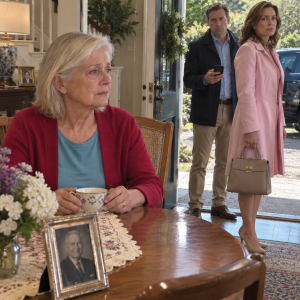
“My money was welcome,” I said, “but my son was not. That arrangement is over.”

The Papers in the Desk

Relatives had begun gathering in the doorway. My uncle Thomas asked what the payments were for, and my mother repeated that she had medical expenses. I asked to see one invoice. She had none.

During those same months, my parents renovated their lake house deck, replaced kitchen appliances, and spent a weekend in Charleston. Every expense had come with a convenient explanation.

Ian placed the envelope on the dining table.

“I found this in Richard’s desk when he asked me to look for the spare garage remote.”

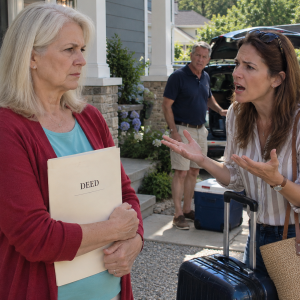
Inside were bank statements, agent emails, and a purchase agreement for a $1.1 million house near Dublin, Ohio. My parents had placed a $40,000 deposit and presented my transfers as permanent family support.

There was also a signed statement claiming that I had agreed to cover any shortfall for five years.

At the bottom was a version of my signature.

It looked close, but it was not mine.

“You used my name without permission,” I said.

My father gave a thin, uneasy laugh. “It was only preliminary paperwork.”

“You told me the money was for Mom’s heart care.”

“The property would have benefited everyone,” my mother said. “It was an investment for the family.”

“Would Elliot have benefited too?” I asked. “The child who was not allowed through the door tonight?”

She looked down.

Ian turned to Molly. Her name appeared as a witness on one of the forms.

“Did you sign this?”

“Dad said Caroline had already agreed,” she answered. “He said the agent needed everything quickly.”

“You also told me you were contributing every month,” Ian said. “What part of this did you actually believe?”

Molly pressed both hands to her face. “I thought I was keeping everyone together.”

“Helping them pressure a grieving mother is not keeping a family together,” I said. “You knew where that money came from.”

My father tried to take the documents, but Ian pulled them back.

“These stay with Caroline.”

Then my father lowered his voice, using the same tone he had used throughout my childhood whenever he wanted me to question my own judgment.

“You have had an emotional year,” he said. “Be careful. If you create a public mess, people could start asking whether you are stable enough to raise Elliot alone.”

My uncle Thomas stepped between us.

“Say one more thing about taking that boy from his mother, and I will make the call myself.”

I opened the recorder on my phone.

“Please repeat what you just said.”

My father went silent.

I finally understood his method: provoke fear, wait for my reaction, then use it as proof that I was unreasonable. That night, however, there were witnesses and documents.

“You taught me that asking for respect was the same as causing trouble,” I told him. “I don’t believe that anymore.”

Leaving the House Behind

I blocked my parents’ numbers. Then I blocked Molly’s.

My mother stared at my phone. “You cannot keep us from our grandson.”

“You chose not to see him tonight.”

“That was one evening.”

“It was the clearest summary of how you have treated him all year.”

My father insisted Elliot was difficult because he touched things and asked inconvenient questions.

“He is seven,” I said. “He misses his father, and he is trying to understand the world. Anyone who sees that as a burden does not get private access to him.”

Molly accused me of punishing her daughters.

“They have done nothing wrong,” I replied. “But I will not let them be used to teach Elliot that he matters less.”

Ian gathered his children, and other relatives followed. Uncle Thomas said he would not celebrate where one child had been singled out for being curious. Within twenty minutes, the rooms were nearly empty.

At the front door, Molly reached toward me.

“I’m sorry,” she whispered.

“For what?”

“For helping them.”

“That tells me what you did. It does not tell me why.”

She had no answer.

My father followed me onto the porch.

“You will regret turning everyone against us.”

“I did not turn anyone against you,” I said. “I stopped hiding what you did.”

In my car, my hands shook too badly to start the engine. I cried because ending a harmful family pattern still feels like loss when part of you is waiting for people to become who you needed.

Then I thought of Elliot.

At Frank and Louise’s house, he ran to the door with cocoa on his upper lip and a small metal gear in his hand.

“Mom! Grandpa Frank showed me how an old motor works.”

Tools covered the kitchen table. Louise had hung a stocking with Elliot’s name beside the others. No one asked him to be quieter. No one treated his questions as an inconvenience.

After he fell asleep, I showed them the papers.

Louise held my hand and said, “You and Elliot never have to earn a place here.”

What Belonging Really Costs

The next morning, an attorney notified my parents, the real-estate agency, and the lender. The purchase was suspended. A specialist later confirmed that my signature had been copied from an old school authorization form Molly had kept.

The agency produced emails in which my father described me as a widowed daughter who would keep paying out of moral duty. Molly wrote that I disliked conflict and probably would not ask questions.

That sentence hurt more than the copied signature. They had built their plan around the belief that I would accept mistreatment rather than risk being called ungrateful.

I filed a formal report establishing that my name and Elliot’s future were not available for anyone else’s plans. My parents eventually sold their lake house to cover their obligations.

I did not celebrate their loss.

I also did not rescue them from it.

Ian and Molly separated after he uncovered hidden credit cards, private loans, and several other lies. Molly sent long messages that moved between apology and blame. I answered only once.

“An apology without responsibility is another request for me to carry the weight.”

Six months passed. The $1,200 that once went to my parents began going into Elliot’s education account. I enrolled him in a weekend robotics program. On the first morning, he stopped at the classroom door.

“What if the teacher gets annoyed because I ask too much?”

I knelt beside him.

“The right people will be glad you are curious.”

Two hours later, he emerged with a cardboard robotic arm, talking faster than I could follow. Frank helped improve it on weekends, and Louise attended every presentation. Elliot called them Grandma and Grandpa because they had earned those names by showing up.

That winter, my aunt hosted a smaller dinner. Elliot brought Uncle Thomas’s microscope, and the children lined up to examine snowflakes on dark paper. He explained everything with delight, and no one asked him to be quiet.

My parents were not invited. They blamed me, although the decision belonged to the relatives who had watched the truth unfold.

The following spring, on the anniversary of losing Peter, Elliot and I visited the park where we had taken our favorite family photograph. He carried the improved robotic arm Frank had helped him build.

“Dad would have liked this,” he said.

“He would have asked you a hundred questions.”

Elliot smiled.

“I would have answered every one.”

In that moment, I understood what I had protected on Christmas Eve. It was not merely an account or a document. It was the part of my son that believed his curiosity deserved patience, his sadness deserved gentleness, and his presence deserved a chair at the table.

Family is proven by the people who arrive when helping is inconvenient, who listen to the tenth question, and who welcome a child without calculating what they will receive in return.

Elliot will never again stand outside a celebration wondering why everyone else was allowed in.

Where he is respected, loved, and free to ask questions, that is where our family will be.

Related Posts

My Ex-Wife Laughed At The Scratched Watch On My Wrist During Our Reunion. Minutes Later, She Learned That The Quiet Contractor She Once Left Behind Had Become The Founder Of One Of New England’s Most Respected Infrastructure Companies. The Watch Had Never Measured Wealth. It Measured Character.

Part 1 – The Divorce Papers Beside The Christmas Ham Nine years before the reunion, my wife handed me divorce papers while my mother was still cutting her...

My Mother Called 911 Because My 5-Year-Old Wouldn’t Give Up Her Birthday Doll—And Told Her, “Your Mom Will Be Ashamed Of You.” I Came Home To Find Her Shaking Before Two Officers, Quietly Collected The Official Report, Blocked My Family From Her School, And Saved Every Message… Days Later, An Unfinished Call Exposed What They Had Planned.

The Morning I Came Home Early My mother was standing in the middle of my living room, pointing at my five-year-old daughter as though she were identifying a...

I Lied to My Exhausted Wife Just Weeks After She Gave Birth So I Could Secretly Spend the Day Buying Luxury Gifts for Another Woman—But When I Finally Came Home, My Wife and Newborn Daughter Were Gone, and the Thick File She Left on Our Bed Revealed She Had Known Every Lie I Told Long Before I Ever Suspected… Yet the Final Page Exposed a Truth That Changed Everything I Thought I Knew

The Promise I Never Intended to Keep My name is Nolan Whitaker, and the evening I lost my family did not begin with an argument. There was no...

I Thought My Greatest Regret Was Walking Away from My First Wife Because I Believed I Could Never Have Children—Until a Doctor Told Me I Had Never Been Infertile, and Just Hours Later, I Found My Ex-Wife Holding the Hands of Two Young Twins Who Looked Exactly Like Me… But the Secret Behind an Old Fertility Test Led Straight to the Person I Had Trusted Most

The Hospital Hallway That Changed Everything I had always believed the most shocking moment of my life came when a specialist looked across his desk and told me...

“I’m Not Wearing Grandma’s Cheap Old Dress, It’s So Emb@rassing!” My Daughter Said Before Her Future Mother-in-Law Cut It Apart With Scissors in Front of Everyone. I Quietly Picked Up Every Piece of Lace… Three Weeks Later, They Stood Speechless Before the Same Dress Behind Museum Glass.

The Dress She Refused to Touch The white keepsake box slid across the dining table. It stopped inches from my hands. My daughter didn’t even look at me....

Để lại một bình luận

Email của bạn sẽ không được hiển thị công khai. Các trường bắt buộc được đánh dấu *