Part 1 – The Voices Beside The Silent Monitor
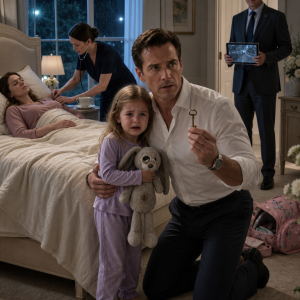
The first thing Jonathan Pierce heard after being declared dead was his wife thanking his closest friend for arranging the accident.
For twenty-six minutes, his body remained motionless beneath a white hospital sheet while awareness returned in fragments. He could not open his eyes, move his hands, or force air deeply enough into his lungs to prove that something inside him had not entirely surrendered.
The cardiac monitor beside his bed displayed a flat line. At 6:18 on a gray Tuesday morning, Dr. Melissa Grant ended resuscitation efforts and announced the time of death.
Nurses quietly removed several emergency instruments before leaving the room to complete the necessary paperwork. Jonathan’s wife, Rebecca, had spent the previous three weeks performing grief before relatives, employees, reporters, and nearly eighty visitors who gathered throughout the intensive care wing.
She had cried against the shoulders of company executives, praised Jonathan’s devotion, and told everyone that she would preserve the trucking business he had built from nothing.
When the medical staff departed, Rebecca’s crying stopped immediately.
Another person entered the room.
Jonathan recognized the measured footsteps before the man spoke.
Michael Turner had been Jonathan’s college roommate, best man, business partner, and closest friend for more than twenty years. Jonathan had once trusted Michael with account passwords, emergency decisions, and the lives of hundreds of employees.
Michael stood beside the bed and spoke quietly.
“The state police closed the accident investigation yesterday. Heavy rain, loss of control, mechanical failure, and no evidence of outside involvement.”
Rebecca released a shaky breath.
“What about the sedative?”
“The hospital administered so many medications afterward that any remaining trace should be difficult to separate. Once the cremation authorization is signed, nothing important will remain.”
Jonathan tried to move his fingers, but his body offered no response.
Rebecca took Michael’s hand.
“Thank you for making it look like an accident. Now Pierce Freight will finally belong to us.”
Michael gave a low laugh.
“The board meeting is already scheduled. Once the death certificate is filed, I become acting chief executive and you retain control through the amended shareholder agreement.”
“Jonathan would have discovered the missing payments eventually.”
“That problem no longer exists.”
Their voices receded toward the door.
Only after they left did Jonathan’s heart produce one weak beat.
Then another.
The monitor emitted a single tone, followed by an irregular sequence that drew a nurse back into the room. She froze when she saw the line moving and Jonathan’s right index finger twitching beneath the sheet.
Dr. Grant returned with the emergency team.
Jonathan’s circulation had resumed spontaneously after resuscitation had ended, an uncommon phenomenon sometimes described as delayed return of spontaneous circulation. The doctor immediately reopened treatment, although she struggled to reconcile the man before her with the death certificate waiting on her computer.
Several hours later, Jonathan opened his eyes.
He could barely speak, but he understood enough to make one request.
“Do not tell my wife.”
Dr. Grant leaned closer.
“Mr. Pierce, she has legal authority as your spouse.”
“She tried to kill me.”
The accusation might have sounded confused if his expression had not been so focused.
Jonathan asked her to contact his younger sister, Dr. Laura Pierce, an emergency physician working across the city. When Laura arrived, she initially believed someone had made a cruel mistake.
Then she saw her brother alive.
She held his hand and cried until he whispered the words he had heard beside the silent monitor.
Laura stopped crying.
“We are not confronting them,” she said. “We are going to prove everything first.”
Part 2 – The Accident On Interstate 94
Three weeks earlier, Jonathan had left the headquarters of Pierce Freight shortly after ten o’clock at night.
The company occupied a renovated warehouse near Milwaukee’s Menomonee Valley and managed more than seventy long-haul trucks across Wisconsin, Illinois, Minnesota, Michigan, and Indiana. Jonathan had founded the business at twenty-seven with one refrigerated truck purchased through a bank loan secured by his mother’s house.
At forty-five, he still knew drivers by name and regularly worked beside mechanics when equipment failed before dawn.
Rebecca served as chief financial officer. Michael owned twelve percent of the company and led commercial operations. Together, the three of them appeared inseparable during industry conferences, charity dinners, and investor meetings.
Jonathan had trusted both of them completely.
The night of the crash, a storm transformed Interstate 94 into a corridor of standing water and reflected headlights. Jonathan remembered drinking coffee in Rebecca’s office before leaving. The beverage tasted unusually bitter, but she blamed a new brand of beans.
Thirty minutes later, his vision blurred.
When traffic began descending toward a long curve, he pressed the brake pedal.
It dropped without resistance.
He pressed again, but the truck continued accelerating.
Jonathan steered away from another vehicle before crashing through a guardrail and striking a concrete barrier. The impact shattered glass, crushed metal, and erased nearly everything that followed.
State investigators initially concluded that water, fatigue, and brake failure caused the accident.
Rebecca told police that Jonathan had been working too hard and frequently ignored her requests to rest. Michael provided maintenance documents showing that the vehicle had passed inspection.
Both statements were carefully prepared.
After Jonathan regained consciousness, Laura asked the hospital laboratory to preserve blood samples taken immediately after the crash. Independent testing identified a strong sedative that had never been prescribed to him and could not be explained by emergency treatment.
Laura contacted Nathan Brooks, an attorney who had represented the Pierce family for decades. Nathan arranged for Jonathan to be transferred under another patient designation to a secure rehabilitation unit outside Milwaukee.
Rebecca received official notice that the hospital had delayed releasing Jonathan’s body because of administrative questions. Michael encouraged her to approve immediate cremation, but Nathan quietly blocked every request.
Jonathan remained hidden while recovering enough strength to stand.
The first person from Pierce Freight brought into the secret was his executive assistant, Rachel Monroe. She entered the rehabilitation apartment expecting to meet Laura and nearly collapsed when Jonathan walked slowly into the living room with a cane.
“Everyone believes you are dead,” Rachel whispered.
“For now, that belief is useful.”
Rachel had worked beside Jonathan for nine years and had recently noticed irregular vendor payments. She carried encrypted copies of invoices, email approvals, and accounting reports she had saved after Rebecca ordered several records deleted.
Three consulting firms had received more than eight hundred thousand dollars over twenty-two months. All three used the same postal address outside Madison, possessed no employees, and provided no transportation services.
Michael approved the invoices. Rebecca released every payment.
Rachel also brought a copy of a shareholder amendment filed three months before the accident. The document transferred emergency voting authority to Michael upon Jonathan’s death and granted Rebecca control over Jonathan’s family shares.
The signature resembled Jonathan’s, but he had never seen the document.
Nathan examined the pages.
“They were not waiting for an accident. They prepared for one.”
Part 3 – The First Attempt They Thought He Forgot

The deeper investigation uncovered something Jonathan had dismissed two years earlier.
During a company retreat near Door County, Jonathan had gone boating with Rebecca and Michael. The engine failed several miles from shore, and his life jacket tore when he entered the water to inspect the propeller.
A passing fishing boat rescued him after he became exhausted in the cold lake.
At the time, Rebecca called the event a terrifying accident and insisted that Jonathan replace every piece of safety equipment.
Rachel found an insurance draft prepared six days before the trip. It described the anticipated loss of the boat, personal property, and accidental death benefits connected to Jonathan.
The claim was never submitted because he survived.
A marine technician later examined photographs from the damaged life jacket and concluded that the fabric had been cut before the trip. The boat’s fuel line had also been loosened using a tool rather than deteriorating naturally.
Jonathan sat silently after Nathan explained the findings.
“They tried before,” he said.
Laura placed a hand on his shoulder.
“We cannot prove who cut the jacket from photographs alone.”
“But they prepared the insurance paperwork before the boat failed.”
“That proves planning,” Nathan replied. “Combined with the current evidence, it establishes a pattern.”
Federal investigators joined the case after Nathan submitted the forged corporate documents, interstate payments, and evidence of attempted murder.
Special Agent Dana Mitchell advised Jonathan to remain officially dead until they could capture direct statements or recover physical evidence connecting Rebecca and Michael to the crash.